Forex Spread Widening Around News: Why It Happens and What It Costs You
Short answer: The spread is the gap between the bid and ask price, and it can widen sharply when liquidity thins or uncertainty jumps: major news releases, the daily rollover period and the weekly open are common examples. A spread that moves from 1 pip to 5 pips on EUR/USD costs about $50 instead of $10 per standard lot to enter. It can also trigger a stop loss on a short trade even if the bid price has not moved.
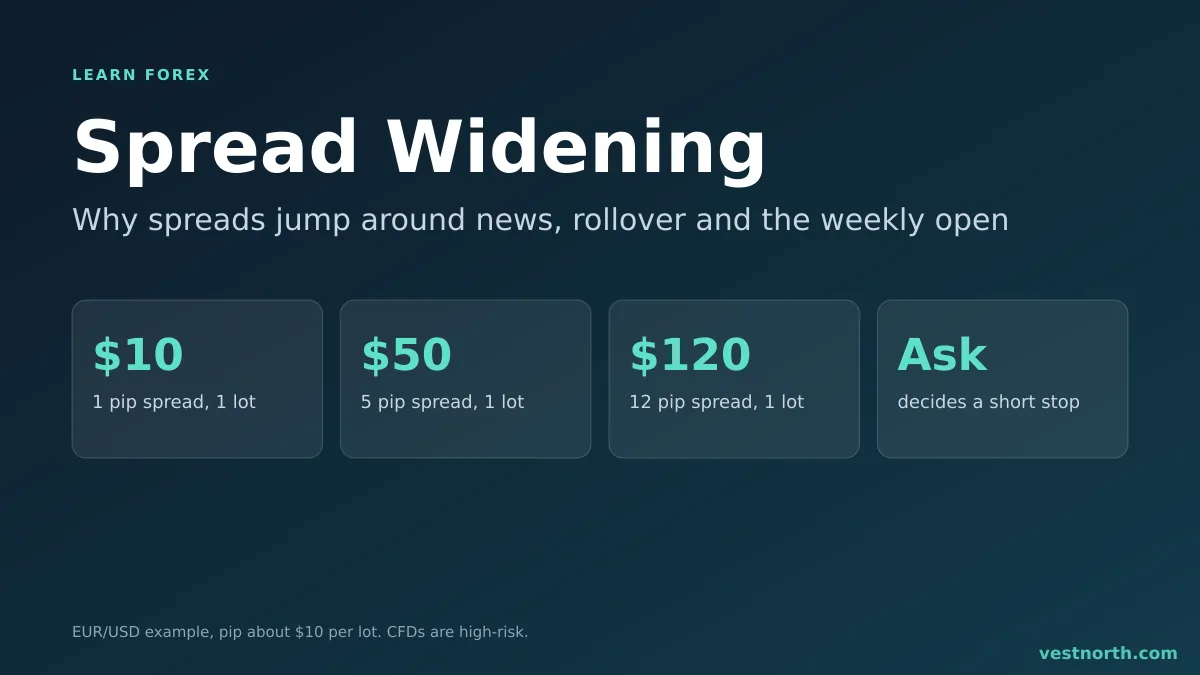
Spread cost per standard lot on EUR/USD. Illustration, November 2026.
Why spreads widen
A broker quotes a bid (the price you sell at) and an ask (the price you buy at). The difference is the spread. It reflects how easily a trade can be matched. When many buyers and sellers are active, quotes are tight. When they are not, the gap grows.
Three things push spreads out:
- Uncertainty. Before a data release, liquidity providers do not know where fair value will be seconds later. Wider quotes protect them.
- Fewer quotes. Some providers pull their prices briefly around the event, so the best bid and best ask are further apart. See liquidity.
- Fast movement. If price jumps, the broker’s feed updates in steps, and the quoted spread can stretch between steps.
When it tends to happen
| Time | Why |
|---|---|
| Major scheduled releases | Interest-rate decisions and employment data can move prices within seconds. See the economic calendar. |
| Daily rollover | Liquidity is thin as the trading day changes. See rollover. |
| Market open after the weekend | Few participants are active in the first minutes and a gap can appear. |
| Holidays and late sessions | Fewer participants. See trading sessions. |
| Unscheduled shocks | Surprise statements or events with no calendar entry. |
The exact times and amounts differ by broker, account and pair. Your broker’s trading conditions page is the place to check what it says about spreads at rollover or during news.
What a wider spread costs
The cost of the spread is paid the moment you open a trade. For a pair where one pip equals $10 per standard lot (such as EUR/USD quoted in US dollars), the cost is:
Spread cost = spread in pips × pip value × lots
| Spread | 0.10 lot | 1.00 lot |
|---|---|---|
| 1 pip | $1 | $10 |
| 3 pips | $3 | $30 |
| 5 pips | $5 | $50 |
| 12 pips | $12 | $120 |
On a 1.00-lot trade at a 5-pip spread, the market must move 5 pips in your favour just to bring the position to break-even. If your target was 20 pips, 25% of it is already used by the spread. Use the pip calculator to get the pip value for your pair and lot size, and read pip value if that is new.
How a wider spread can trigger your stop
Long positions close on the bid. Short positions close on the ask. Many price charts draw only one of them, often the bid, so a chart may show no move while the other side of the quote jumps.
Example: you sold EUR/USD with a stop-loss buy order at 1.0810.
- Before the release: bid 1.0800, ask 1.0801 (1 pip spread).
- During the release: the bid is still 1.0800, but the ask is 1.0812 (12 pip spread).
- Your stop to buy at 1.0810 is triggered because the ask passed it.
The chart shows the bid sitting at 1.0800, yet the position closes with a loss of about 10 pips plus the spread. Traders then see the wider quote vanish a few seconds later and suspect manipulation. In most cases the widening itself is the cause. Whether a given broker handles this in a particular way is in its order execution policy, so read that document. Related: stop loss and the stop hunt explainer.
Spread, slippage and gaps are different costs
| Term | What it is |
|---|---|
| Spread | The standing gap between bid and ask |
| Slippage | The difference between the price you asked for and the price you got |
| Gap | A jump between one price and the next with nothing traded in between |
A news release can produce all three at once. A stop order triggers at its level but fills at the next available price, which may be worse. This is why a stop loss limits risk but does not guarantee the exit price.
Fixed spreads and variable spreads
Some accounts quote a fixed spread and others a variable one that follows the market. Fixed does not mean it never changes: brokers usually state conditions under which a fixed spread can widen or an order can be requoted. Variable spreads are shown live. Commission-based accounts often quote a tight raw spread plus a separate charge, covered in spread vs commission. Whichever you use, look for the broker’s written terms for news and rollover.
Practical ways traders handle it
These are examples of approaches, not advice:
- Check the economic calendar and decide before the release whether to hold, reduce or close.
- Avoid opening positions in the minutes around rollover.
- Use smaller position size when a release is due, since stops can be filled further away than planned.
- Compare the live spread to the usual one before placing an order. A pair that normally quotes 1 pip and now shows 8 is telling you something.
- Learn the rules for news trading on a demo account first.
Common mistakes
- Placing a tight stop just before a release. The spread alone can reach it.
- Reading the chart’s bid line as the full quote. A short position depends on the ask.
- Judging a broker on its quietest-hour spread. Check the figure at busy times as well.
- Adding to a position during the move. The cost of the spread is paid again on each entry.
Bottom line
A spread that jumps from 1 to 5 pips costs about $50 per standard lot on EUR/USD instead of $10, and a short trade’s stop depends on the ask, which can leave the chart’s bid line behind. Spreads tend to widen at major releases, rollover and the weekly open. Check the live quote before you trade, keep size small around events, and read your broker’s terms for what it says about news. Only trade with money you can afford to lose, because leveraged trading can lose value quickly.
Frequently asked questions
Why does the spread widen during news?
Liquidity providers quote wider prices or pull quotes when a release could move the market sharply. With fewer and wider quotes, the gap between bid and ask grows.
When does the spread usually widen?
Common times are major scheduled releases, the daily rollover period, the market open on Sunday evening and thin holiday sessions. Check your broker for its own rollover time.
How much does a wider spread cost?
Multiply the spread in pips by the pip value and the lot count. On EUR/USD with one standard lot, one pip is about $10, so a 5-pip spread costs about $50 against $10 at 1 pip.
Can a wider spread trigger my stop loss?
Yes. A buy position closes on the bid price and a sell position on the ask price. If the ask rises because the spread widens, a stop on a short trade can be hit while the bid has not moved.
Do all brokers widen spreads in the same way?
No. Fixed and variable spread accounts behave differently, and each broker sets its own terms. Read your broker's trading conditions instead of assuming.
Should I avoid trading during news?
That is a choice. Many traders stay out, close positions earlier or use smaller size, because of wider spreads, slippage and fast moves.