What Is Copy Trading? How It Works and What Can Go Wrong
Short answer: Copy trading links your trading account to another trader’s, so their trades are repeated on your account in proportion to the money you allocate. You do not choose each entry. Your account takes the same losses as the provider’s trades, plus fees and any delay in copying, and a good past record does not predict future results.
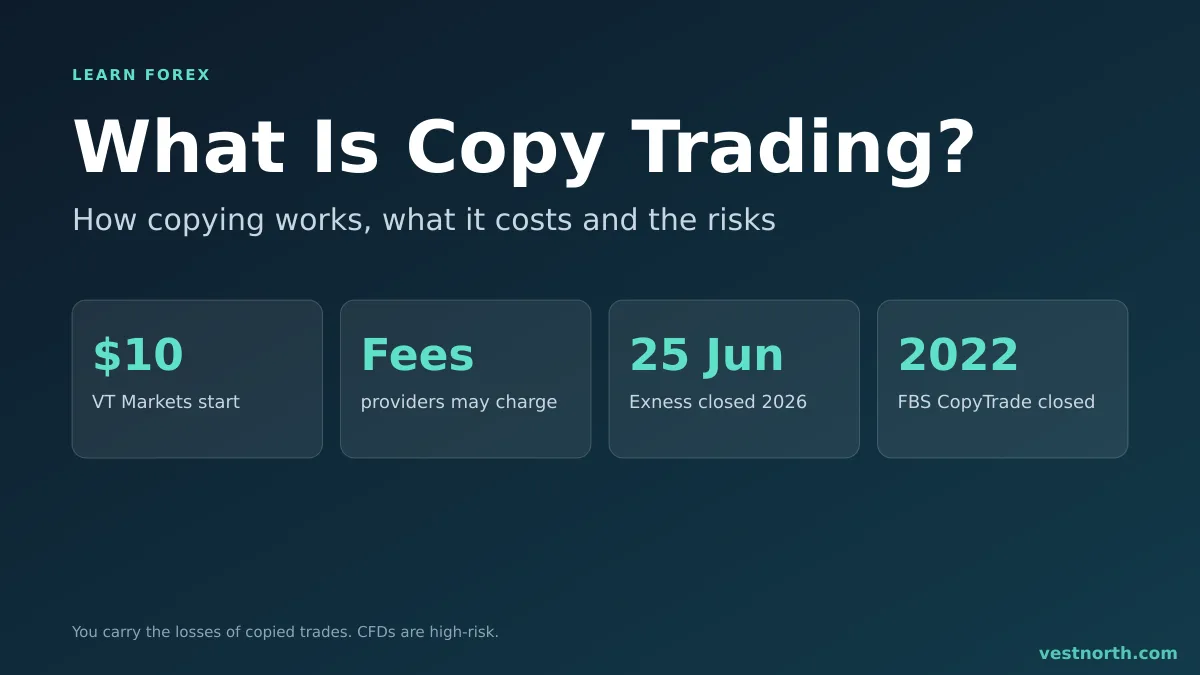
Copy trading in figures from our broker reviews, October 2026.
Copy trading meaning: what a “copy trade” is
A copy trade is a single position opened on your account because the provider you follow opened it. Copy trading (also written “copytrading” or “copy trade”) is the arrangement as a whole: you choose who to follow, how much to allocate and what limits to set, and the platform does the rest. Social trading is a wider term for platforms where traders share ideas, and many include copying.
How copy trading works
A provider (also called a strategy or signal provider) trades a live account. A follower picks that provider and allocates money. When the provider opens, changes or closes a trade, the platform repeats it on the follower’s account.
Position sizes scale with the amount you allocate. If the provider risks 2% of a large account and you allocate a small one, your trade is smaller in money terms but similar in percentage terms. Platforms differ on how they scale, so read the rules of the one you use.
Where you can find it
Our reviews report the following, from each broker’s own pages:
| Broker | Copy trading, per our review |
|---|---|
| VT Markets | Built into the app and client portal from $10. VTrade social trading and PAMM also exist |
| Vantage | Copy trading in the app, plus third-party options such as Myfxbook AutoTrade, ZuluTrade and DupliTrade. PAMM and MAM exist |
| Axi | A separate Axi Copy Trading app linked to your MT4 or MT5 account |
| AvaTrade | DupliTrade and ZuluTrade, plus AvaSocial |
| Exness | Closed on 25 June 2026 |
| FBS | FBS CopyTrade closed on 22 September 2022 |
See the VT Markets review, the Vantage review, the Axi review, the AvaTrade review, the Exness review and the FBS review. Features can change, so check the live page before you rely on one. Reviews that still promote Exness copy trading are out of date.
What you need for a copy trading account
- A live account at a broker that supports copying, held by a legal entity you have checked. The table above shows which of our reviewed brokers offer it.
- The copy app or portal the broker uses, or a third-party platform linked to your MT4 or MT5 account.
- A minimum allocation. Our VT Markets review reports copy trading from $10. Other platforms set their own minimums.
- Your own risk settings: the amount per provider, a stop on the copy if offered, and a leverage level you are comfortable with.
Most platforms let you browse providers before you fund the account. Some brokers also offer a demo account, see what a demo account is.
Copy trading pros and cons
| Advantages | Disadvantages |
|---|---|
| You do not need to place or time each trade | You take every loss the provider takes, in proportion |
| You can start with a small allocation | Performance fees can apply on top of spread, commission and swap |
| You can study a provider’s record and drawdown first | Past results do not predict future ones, and short records mislead |
| You can stop copying or withdraw at any time on most platforms | Your fills can differ from the provider’s in fast markets |
| You can spread money across several providers | Several providers on correlated pairs act like one large trade |
Copy trading vs trading yourself
| Copy trading | Manual trading | |
|---|---|---|
| Who picks entries and exits | The provider | You |
| Time needed | Choosing and monitoring providers | Analysis plus placing every trade |
| Costs | Normal trading costs plus any provider fee | Normal trading costs |
| Risk control | Allocation, stop on the copy, leverage | Position size and stop loss on each trade (risk management) |
| What you learn | Little, unless you study the trades | Skills you keep |
Many people combine the two: a small copy allocation while they learn on a demo account.
What it costs
You pay the normal trading costs on every copied trade: the spread, any commission and swaps on overnight positions. See what a spread is and what a swap is.
On top of that, providers may charge a performance fee. The VT Markets review says signal providers may charge performance fees. Read the fee, when it is charged and whether it applies to profit only, before you follow anyone.
The risks people miss
Your losses are real. The platform repeats the provider’s losing trades on your account too. A provider with a high return in the past may have used very high leverage.
Past results do not predict future ones. A short, strong record can come from a few lucky trades or one large risk that has not yet gone wrong. Look at how long the record is and how deep the worst drop was, not only the headline gain.
Your fills can differ. Copying takes a moment, so you may get a different price from the provider, especially in fast markets. Your spread and your account’s leverage may also differ.
Leverage still applies. If your balance falls, a margin call and stop out can close the copied positions. Read what leverage is and margin call and stop out.
Your entity matters. Protection follows the legal company holding your account. See how to choose a forex broker for what to check.
A worked example with a stop on the copy
Say you allocate $300 to a provider and the platform lets you set a stop on the copy at 20% of the allocation.
- If the copied account falls $60, which is 20% of $300, the platform stops the copy.
- Open positions are closed at the market price, which can be worse than the stop level in a fast move.
- You keep $240 minus any costs, and you decide whether to follow anyone else.
Check that your platform offers this kind of limit. Without one, a provider’s open positions keep running on your account.
Copy trading, PAMM and MAM
These terms overlap but differ in how money is handled. In copy trading, each follower keeps a separate account and the platform repeats the provider’s trades. PAMM and MAM set-ups let a manager trade on behalf of investors under a pooled or allocated structure. Our Vantage and VT Markets reviews note that PAMM accounts exist next to the copy options. If you are unsure which one you are signing up to, read the terms before sending money.
Questions to ask before you follow a provider
- How long is the record, and how large was the biggest fall?
- What leverage and position sizes does the provider use?
- What fees apply, and when are they charged?
- Can I set a stop on the copy and withdraw at any time?
- Which company holds my account, and what does its agreement say about losses?
Bottom line
Copy trading hands the entry decisions to someone else and leaves the losses with you. Costs, fees and delays make your result differ from the provider’s. Try the platform on a demo account first if one is offered, keep the allocation small, and set a stop on the copy. Only deposit money you can afford to lose. CFDs are complex, high-risk instruments.
Frequently asked questions
What is copy trading in simple terms?
You pick a trader, called a signal provider or strategy provider, and your account repeats their trades in proportion to the amount you allocate. You do not place the trades yourself.
Is copy trading safe?
No trading method is safe. The provider's results come from past trades, and your account can lose money on the same positions. Leverage, fees and delays can make your results differ.
Does copy trading cost extra?
It can. The VT Markets review says signal providers may charge performance fees. You still pay the normal spread, commission and swap on the copied trades.
Do all brokers offer copy trading?
No. Our reviews report that Exness closed all Copy Trading strategies and investments on 25 June 2026, and FBS closed FBS CopyTrade on 22 September 2022. VT Markets, Vantage and Axi offer copy trading options.
What is the difference between copy trading and PAMM or MAM?
In copy trading each follower's account repeats the provider's trades. PAMM and MAM accounts pool money or allocate trades under a manager. Our Vantage and VT Markets reviews note that PAMM accounts exist alongside copy trading.
What are the advantages and disadvantages of copy trading?
The advantages are that you do not need to place each trade, you can start small and you can see a provider's record first. The disadvantages are that you take the same losses, pay the provider's fees on top of normal costs, and your fills can differ from theirs.
What is a copy trading account?
It is a normal live trading account at a broker that is linked to a copy trading platform or app. The money stays in your account, and the platform repeats the provider's trades on it.
Can I lose more than I put in?
It depends on the broker and entity. Check negative balance protection in the client agreement of the entity that holds your account, and the stop loss or equity limit you set for the copy.