What Is a Round Number Level in Forex? Psychological Levels Explained
Short answer: A round number level is a price ending in zeros, such as 1.1000 on EUR/USD or 150.00 on USD/JPY. Traders often place orders, targets and stops at these easy numbers, so price may pause, bounce or spike there. Half levels such as 1.1050 are watched too. They are a reference zone, not a wall: price can stall a few pips before the number, pass straight through it, or touch it and reverse. Use them with another reason, and put stops beyond the level, not on it.
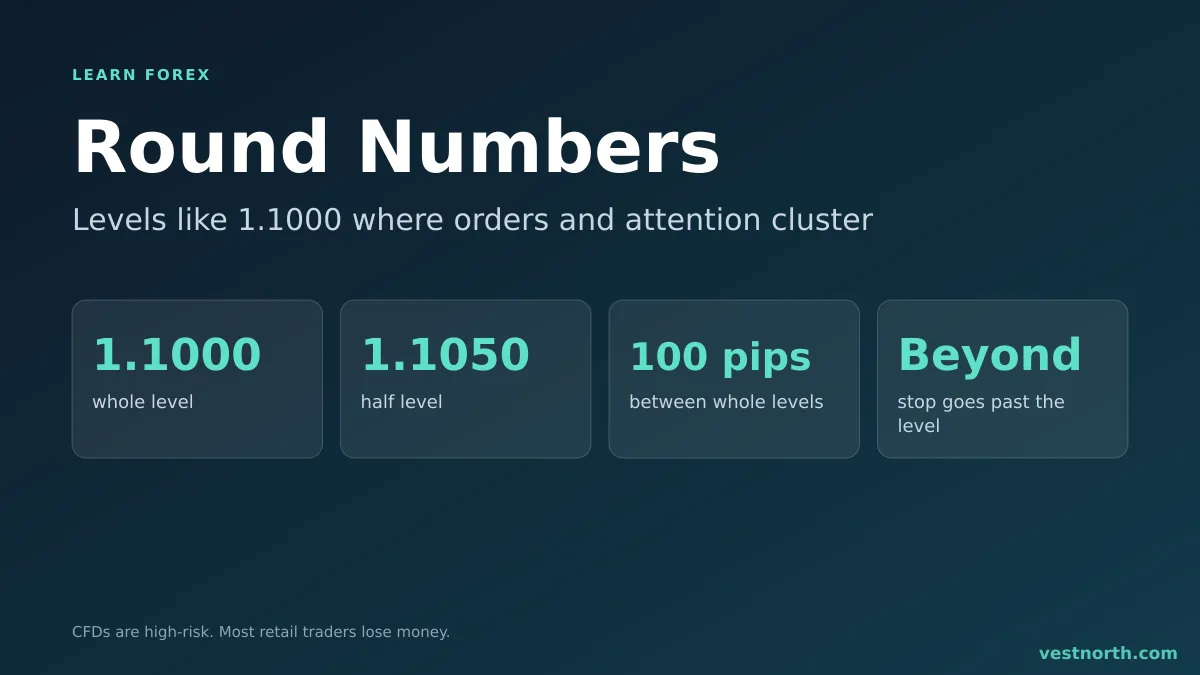
Round number zones on a chart. Illustration, November 2026.
What counts as a round number
Currency prices have four or five decimal places (two or three on yen pairs). A “round” price is one that ends in zeros.
| Pair | Example levels | Names traders use |
|---|---|---|
| EUR/USD | 1.1000, 1.0900 | The figure, the big figure |
| EUR/USD | 1.1050, 1.0950 | Half figure |
| GBP/USD | 1.2500, 1.2600 | Whole and half levels |
| USD/JPY | 150.00, 149.50 | Round and half level |
The “big figure” is the part of the quote that changes less often. In 1.0850 it is 1.08. A pip is the fourth decimal on most pairs, so the distance from 1.0900 to 1.1000 is 100 pips. See what is a pip.
Why price reacts near them
Nothing in the market forces a reaction at 1.1000. The idea is behavioural:
- Orders cluster. Traders choose easy numbers for take profits, entries and stops, so many pending orders can sit there. See pending orders.
- Options and large orders. Some institutions are said to place orders at round figures. We could not verify how large this effect is, so treat it as a common explanation, not a measured fact.
- Anchoring. People remember and quote round prices, which makes them natural reference points.
The result is that price often behaves oddly near the number: a pause, a quick spike through, or a sharp rejection. Behaviour changes with news, session and trend.
How traders use round numbers
As support and resistance
When 1.1000 coincides with a swing high or a prior support or resistance area, the level has two reasons behind it. Traders look for rejection candles such as a pin bar at the zone.
As profit targets
A trade long from 1.0940 may set a target just under 1.1000, because price may stall there. Putting the target a few pips short avoids missing it when price turns before touching the number.
As breakout levels
A strong close above the number, ideally followed by a retest, can start a breakout. A quick poke above that closes back below is a fakeout.
The stop placement problem
Because many orders sit exactly on the number, price often reaches it, triggers them, and reverses. A stop on 1.1000 itself, or a few pips from it, is easy to hit. This is linked to the idea of stop hunts, although a spike through a level can also be ordinary liquidity.
Practical points:
- Place the stop beyond the level and beyond the swing point, not on the number.
- Allow for the spread. A long position closes at the bid price and a short closes at the ask. See bid and ask.
- Expect slippage in a fast move around news.
Worked example (illustrative figures)
EUR/USD has risen from 1.0900 and approaches 1.1000, where a previous swing high also sits at 1.1002. A trader considers a short from a rejection.
| Item | Level | Distance |
|---|---|---|
| Entry (below the rejection candle low) | 1.0991 | |
| Stop (above the swing high 1.1002, plus buffer) | 1.1018 | 27 pips |
| Target (previous support) | 1.0937 | 54 pips |
| Reward to risk | 2 to 1 |
A stop at 1.1000 would have been only 9 pips away, and a one-candle wick to 1.1006 would have hit it. Placing it at 1.1018 means the trade survives that wick. Risking 1% of a 5,000 USD account (50 USD) over 27 pips gives about 1.85 USD per pip, roughly 0.19 lot where one pip is 10 USD per lot. Use the lot size calculator for your numbers. The levels are invented and are not a signal.
Limits
- They are zones. Treat 1.1000 as an area of a few pips, not an exact price.
- No guarantee. Price can run through a round number without a pause, especially after news. See the economic calendar.
- Weak alone. A round number with no other reason is a thin basis for a trade.
- Crowded. The more traders watch a level, the more stops sit beyond it.
Bottom line
Round numbers are price levels that many traders watch because the numbers are easy to remember. Expect pauses, spikes and rejections near them, but not certainty. Combine them with structure, keep stops beyond the level, and size the position from the stop. Test your approach on a demo account first. Only risk money you can afford to lose. CFDs are complex, high-risk instruments.
Frequently asked questions
What is a round number in forex?
It is a price that ends in zeros, such as 1.1000 on EUR/USD or 150.00 on USD/JPY. Half levels like 1.1050 and 1.0950 are often watched too. Traders call them psychological or big figure levels.
Why do round numbers act as support and resistance?
Many traders place orders, targets and stops at easy numbers. That concentration of attention can produce pauses or reversals at the level. It does not happen every time, and we have no verified statistic for how often.
What is a big figure in forex?
It is the part of the price that changes less often, usually the first digits. In 1.0850 the big figure is 1.08. Some traders also call whole levels such as 1.0800 the figure.
Should I put my stop loss exactly on a round number?
It is safer to place it a little beyond. Many orders sit at the exact number, so price often touches it and reverses, and a stop placed there can be hit by a wick.
Do round numbers work on all pairs?
They are watched on most pairs. On yen pairs the round levels sit at figures like 150.00, and the 0.50 steps matter too. The effect is easier to see on busy pairs.
How is a round number level different from support and resistance?
Support and resistance come from past price action. A round number is a level that exists because of how numbers look. The two are strongest when they coincide.
Can round numbers be combined with other tools?
Yes. A round number that also matches a swing high, a moving average or a Fibonacci level gives more than one reason for the trade.