Scaling In and Pyramiding in Forex: How Adding to a Winner Changes Your Risk
Short answer: Scaling in means building a position in steps instead of one order. Pyramiding adds to a trade that is already in profit, usually with smaller size each time, and moves the stop loss up so the total risk stays under one fixed limit. Adding to a trade that is losing is averaging down, and it raises risk instead of lowering it. In the example below, a four-unit position in EUR/USD has a worst case of a $4 gain after the third entry, because the stop sits above the first two entries.
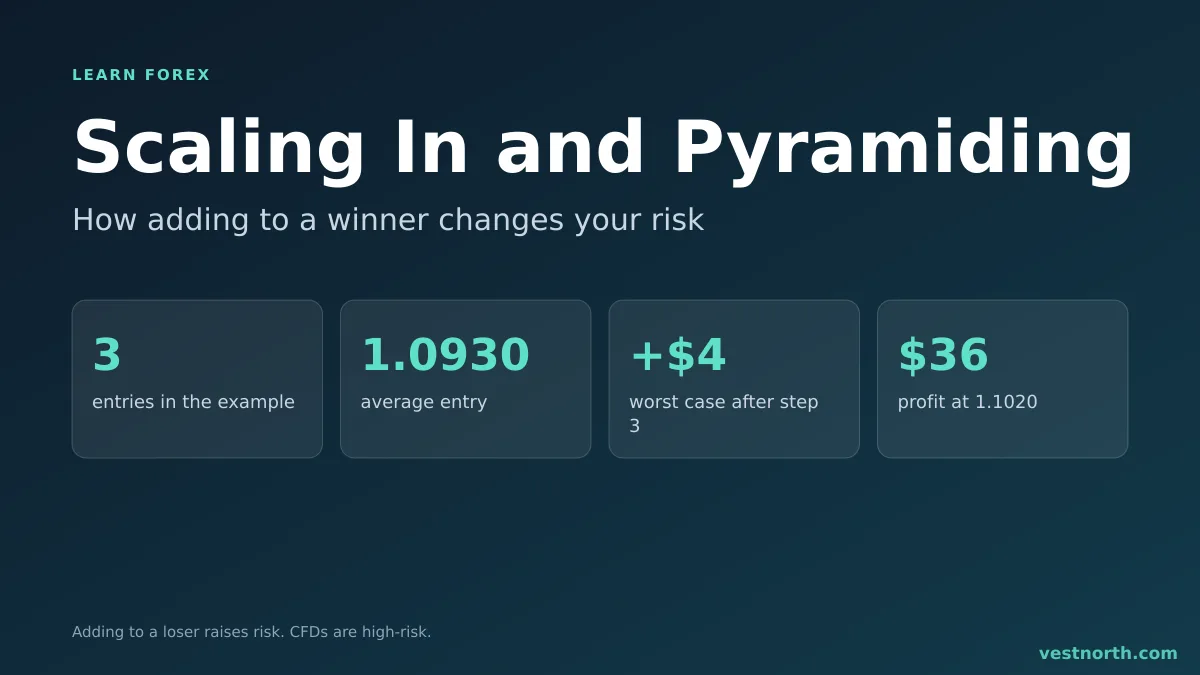
Scaling in with a rising stop. Illustration with made-up prices, November 2026.
Two kinds of scaling in
| Pyramiding | Averaging down | |
|---|---|---|
| Added when price is | In your favour | Against you |
| Stop loss | Moves toward profit | Often left where it was, or removed |
| Total risk after the add | Same or lower, if sized correctly | Higher |
| Average entry price | Worse than the first fill | Better than the first fill |
| What the add says | The idea is working | The idea is being tested |
Both change the average entry price. The difference is what happens to the risk. A pyramid is built from profit, so the stop can protect the earlier entries. An averaged-down position has a larger size at a price where the original idea has not worked yet.
The risk rule that keeps a pyramid safe
Decide the risk for the whole idea before the first order. A common choice is the 1% rule from risk per trade: on a $1,000 account that is $10. Every add has to fit inside that figure at the moment you place it, using the stop you will actually use.
Three checks before an add:
- The first entry has moved far enough that the stop can go to break-even or better. See break-even stops.
- The new entry is no larger than the previous one.
- If the whole stack hit the new stop now, the result would be inside your risk limit.
If the third check fails, skip the add. The position sizing page shows how to turn a stop distance into a lot size.
A worked pyramid on EUR/USD
All prices are made up. One pip on EUR/USD is worth about $10 per standard lot, so $0.10 on a 0.01 lot. The plan risks $8 on the first entry.
- Entry 1: buy 0.02 lot at 1.0900, stop at 1.0860 (40 pips). Risk: 40 x $0.20 = $8.
- Entry 2: price reaches 1.0940, 40 pips in profit. Buy 0.01 lot and move the stop on everything to 1.0900.
- Entry 3: price reaches 1.0980. Buy 0.01 lot and move the stop on everything to 1.0940.
The worst case if the stop is hit after each step:
| After step | Position | Stop | Result if stopped |
|---|---|---|---|
| 1 | 0.02 lot from 1.0900 | 1.0860 | -$8.00 |
| 2 | adds 0.01 lot from 1.0940 | 1.0900 | 0.02 lot: $0; 0.01 lot: -$4.00. Total -$4.00 |
| 3 | adds 0.01 lot from 1.0980 | 1.0940 | 0.02 lot: +$8.00; 0.01 lot: $0; 0.01 lot: -$4.00. Total +$4.00 |
The average entry after step 3 is (2 x 1.0900 + 1.0940 + 1.0980) / 4 = 1.0930. The stop at 1.0940 is 10 pips above it, which is why the stack cannot lose at that stop on paper.
If price keeps rising to 1.1020 and the whole 0.04 lot is closed there, the profit is 90 pips x $0.40 = $36. The same idea with a single 0.02 lot entry at 1.0900 would have made 120 pips x $0.20 = $24. The pyramid made more because the extra lots joined a move that continued.
What can go wrong
Pyramiding pays only if the trend continues for a long time after each add. Several things work against it.
- The last add has the worst price. A small pullback can hit the new stop, and the later entries lose while the first one keeps its gain.
- Stops move closer to price. The tighter the stop, the more often a normal pullback ends the position. A pullback of 30 pips is routine on a 4-hour chart.
- Gaps and slippage. A stop is not a guaranteed exit. In fast markets such as news releases, the fill can be worse than the stop price, so the “worst case” in a table is a plan, not a promise.
- Margin grows. Four lots of margin sit behind one idea. Watch the margin level, because a drop in equity can bring a margin call and stop out sooner than a single position would.
- Fees add up. Each entry pays the spread. Four orders pay it four times.
Why averaging down is a different habit
Averaging down means buying more as price falls and the first entry is losing. Take 0.02 lot bought at 1.0900 with price now at 1.0860. Adding 0.02 lot at 1.0860 moves the average to 1.0880 and doubles the size. If the original stop at 1.0860 is cancelled to “give it room”, there is no loss limit left. A further 100 pips against a 0.04 lot costs $40, and a further 200 pips costs $80, with no plan to say where the idea ends.
The related method of doubling after every loss is covered in the martingale guide.
How to plan a scale-in
- Write the maximum risk for the whole idea in dollars.
- Set the first stop from the chart, for example below a recent swing low, and size the first entry from it.
- Define the trigger for each add in advance, such as a fixed number of pips or a new higher low.
- Set the stop for each stage so the combined loss never exceeds the limit.
- Cap the number of adds. Three entries is a plan, an open-ended ladder is a hope.
- Use a trailing stop or manual moves, and record every step in a trading journal.
- Practise on a demo account before using real money.
The method belongs to trend trading. In a sideways market there is no move to add to, and the entries pile up near the middle of a range.
Bottom line
Scaling in splits one trade into several entries. Adding to a winner can let a position grow from profit while the stop moves up, but the later entries always have a worse price, and a normal pullback can end the stack early. Set one risk figure for the whole idea, size each add to fit it and limit the number of adds. Never add to a losing trade to avoid taking a loss. Only trade money you can afford to lose, because CFDs are high-risk instruments.
Frequently asked questions
What does scaling in mean in forex?
Scaling in means opening a position in several parts instead of all at once. The parts can be added as price moves in your favour (pyramiding) or as price moves against you (averaging down).
What is pyramiding in forex trading?
Pyramiding is adding to a trade that is already in profit. Each new entry is usually smaller than the one before, and the stop loss is moved up so the total risk stays within a limit you set in advance.
Is scaling in the same as averaging down?
No. Pyramiding adds to a winning trade and moves the stop closer to profit. Averaging down adds to a losing trade, so the position and the risk grow while the idea is being proven wrong.
How much should I risk when I scale in?
Set one risk figure for the whole idea, for example 1% of the account, and size every entry so that the combined loss at the stop does not exceed it. Adding a full-size entry on top of a full-size entry doubles the risk.
Does scaling in increase profit?
It can increase profit in a strong trend, because later entries ride the same move. In a market that reverses it can also turn a gain into a smaller gain or a loss, since the average entry price is worse than the first one.
Does scaling in use more margin?
Yes. Every added lot needs margin, so a ladder of entries raises the margin used and lowers the margin level. Check your free margin before each add and see how a margin call is triggered.