Forex Drawdown Explained: How to Calculate It and Why Recovery Gets Harder
Short answer: Drawdown is how far an account has fallen from its highest value, shown as a percentage. The formula is (peak − low) ÷ peak × 100. A fall from $10,000 to $8,500 is a 15% drawdown. The key fact is that recovery is lopsided: after a 50% drawdown you need a 100% gain just to get back to the peak.
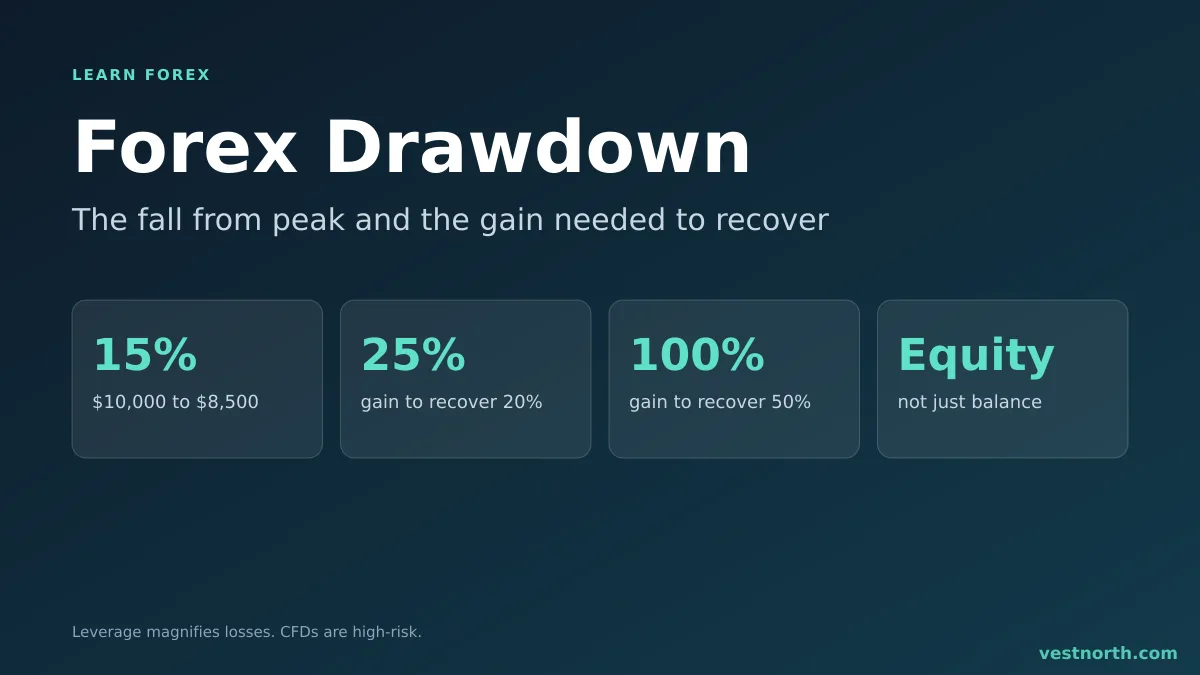
Drawdown in numbers. Illustration, November 2026.
How to calculate drawdown
Take the highest value the account has reached (the peak) and the lowest value it has fallen to afterwards (the trough).
Drawdown % = (peak − trough) ÷ peak × 100
| Peak | Trough | Fall | Drawdown |
|---|---|---|---|
| $10,000 | $9,500 | $500 | 5% |
| $10,000 | $8,500 | $1,500 | 15% |
| $10,000 | $7,000 | $3,000 | 30% |
| $10,000 | $5,000 | $5,000 | 50% |
The base is always the peak, not the starting balance. If the account first grows to $12,000 and then falls to $10,200, the drawdown is $1,800 ÷ $12,000 = 15%, even though the account is still above where it began.
Why recovery gets harder
A loss is measured against the peak, but the recovery gain is measured against the smaller balance you have left. So the gain needed is always larger than the loss:
Gain needed = drawdown ÷ (1 − drawdown)
| Drawdown | Balance left (from $10,000) | Gain needed to recover |
|---|---|---|
| 5% | $9,500 | 5.3% |
| 10% | $9,000 | 11.1% |
| 20% | $8,000 | 25% |
| 30% | $7,000 | 42.9% |
| 50% | $5,000 | 100% |
| 75% | $2,500 | 300% |
This is the main reason experienced traders cap losses early. Going from a 10% to a 20% drawdown more than doubles the gain you need, from 11.1% to 25%. Deep drawdowns are hard to climb out of because the arithmetic works against you.
Balance drawdown and equity drawdown
Your trading platform shows several account values:
- Balance: deposits plus closed trade results.
- Equity: balance plus the floating profit or loss of open trades.
Balance drawdown only moves when a trade closes. Equity drawdown moves with every tick. If you hold a losing trade open instead of closing it, balance looks fine while equity falls. Judge risk on equity, because that is the figure the broker uses for margin level and stop out.
Current drawdown and maximum drawdown
- Current drawdown: today’s value against the most recent peak. It is zero whenever the account sets a new high.
- Maximum drawdown: the largest peak-to-trough fall in the whole record you are looking at.
Performance reports often quote maximum drawdown. Always ask what period it covers and whether it uses balance or equity, because the same history can give very different figures.
Worked example: a losing streak
A trader has a $10,000 account and risks 1% of the current balance on each trade. After five losses in a row:
| Trade | Balance before | Loss (1%) | Balance after |
|---|---|---|---|
| 1 | $10,000.00 | $100.00 | $9,900.00 |
| 2 | $9,900.00 | $99.00 | $9,801.00 |
| 3 | $9,801.00 | $98.01 | $9,702.99 |
| 4 | $9,702.99 | $97.03 | $9,605.96 |
| 5 | $9,605.96 | $96.06 | $9,509.90 |
Five losses cost 4.9%, a little less than 5%, because each risk amount shrinks with the balance. Now compare 5% risk per trade. Five losses leave about $7,738, a drawdown of 22.6%, and the account needs a gain of about 29% to recover. The size of each bet decides how bad a normal losing run gets. See risk per trade and position sizing.
Losing streaks happen even to strategies that win more than half the time. A strategy that wins 60% of trades still has about a 1 in 100 chance of losing 5 trades in a row on any given set of five, since 0.4 to the power of 5 is roughly 0.01. Over hundreds of trades, runs of several losses are normal.
Drawdown and leverage
Leverage lets a small deposit control a large position, so a given price move produces a bigger percentage swing in the account. The same 50-pip move that costs 1% at one position size costs 5% at five times the size. Drawdown depends on position size relative to the account, not on the leverage number itself, but high leverage makes it easy to run a large position by accident. The account size and leverage guide shows the arithmetic.
Setting a drawdown limit
A written limit decides things before emotions do. Examples traders use:
- A daily loss limit, such as stopping for the day after losing 2% of the account.
- A weekly or monthly limit, such as pausing after a 6% fall.
- Staged reductions, such as halving position size at a 5% drawdown and stopping at 10% to review the trading journal.
These numbers are examples, not recommendations. Pick limits that match what you can tolerate, and put them in your trading plan. Remember that a stop loss can be filled at a worse price in fast markets, so the actual loss can exceed the planned one.
Common mistakes
- Measuring from the starting balance. Drawdown is measured from the peak.
- Watching balance only. Open losing trades are hidden from the balance line.
- Doubling size to recover faster. A bigger position raises the chance of a deeper drawdown.
- Ignoring the order of results. The same wins and losses in a different order produce a different maximum drawdown.
- Comparing returns without drawdown. A 40% yearly return with a 50% drawdown is a different risk from 40% with a 10% drawdown.
Bottom line
Drawdown is the percentage fall from your peak, and the deeper it goes, the larger the gain needed to recover: 20% needs 25%, 50% needs 100%. Track equity, not just balance, size each trade so a long losing run stays shallow, and write down a limit before you need it. Only trade with money you can afford to lose, because leveraged trading can lose value quickly. More on this in risk management.
Frequently asked questions
What is drawdown in forex?
It is the fall from a peak in account value to a later low, usually shown as a percentage. If an account goes from $10,000 to $8,500, the drawdown is 15%.
How do you calculate drawdown?
Subtract the later low from the peak, divide by the peak and multiply by 100. For a $10,000 peak and an $8,500 low: (10,000 - 8,500) / 10,000 = 15%.
What gain is needed to recover from a 20% drawdown?
A gain of 25% on the reduced balance. Losing 20% of $10,000 leaves $8,000, and $8,000 x 1.25 = $10,000.
What is the difference between maximum drawdown and current drawdown?
Current drawdown is the gap between today's value and the latest peak. Maximum drawdown is the largest peak-to-low fall over the whole period you are measuring.
What is the difference between balance and equity drawdown?
Balance drawdown counts only closed trades. Equity drawdown also counts open trades at their current profit or loss, so it is usually larger and closer to what the account is really going through.
How much drawdown is acceptable?
There is no correct figure. It depends on your risk tolerance and strategy. Many traders set a personal limit in advance and reduce size or pause when they reach part of it.