Forex Compounding Explained: The Arithmetic, and Why Losses Compound Too
Short answer: Compounding means each period’s result is applied to a balance that already contains earlier results. The formula is final balance = start × (1 + r)ⁿ. A steady 2% a month on $10,000 gives $12,682.42 after 12 months, against $12,400 with no reinvestment. The same maths works in reverse: a 2% monthly loss leaves $8,858.42 after six months. This page uses arithmetic only. It does not suggest any trader can earn a steady return.
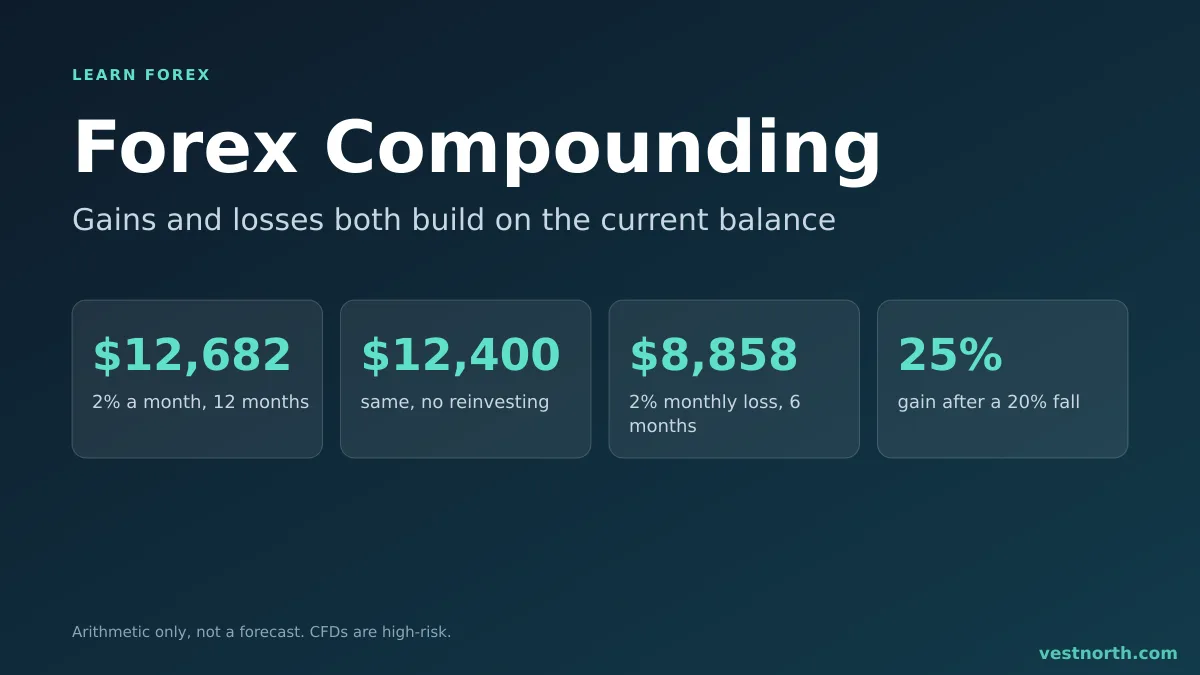
Compounding in numbers. Illustration, November 2026.
Simple growth and compound growth
With simple growth, each period adds the same dollar amount, based on the starting balance. With compound growth, each period adds a percentage of the current balance, so the dollar amount changes.
Take $10,000 and a 2% result each month:
| Month | Simple (adds $200 each month) | Compound (2% of current balance) |
|---|---|---|
| 1 | $10,200.00 | $10,200.00 |
| 2 | $10,400.00 | $10,404.00 |
| 3 | $10,600.00 | $10,612.08 |
| 12 | $12,400.00 | $12,682.42 |
| 24 | $14,800.00 | $16,084.37 |
The gap is small in the first months and grows with time. After 24 months the compound balance is $1,284.37 higher than the simple one. All figures here are plain calculations, not forecasts.
The compounding formula
Final balance = starting balance × (1 + r)ⁿ
- r is the result per period as a decimal (2% = 0.02).
- n is the number of periods.
Example: $10,000 at 1% a month for 36 months is 10,000 × 1.01³⁶ = $14,307.69. For 2% a month over the same 36 months, 10,000 × 1.02³⁶ is about $20,398.87. Doubling the monthly rate more than doubles the gain, because the growth feeds on itself.
Table: what different monthly rates produce
This table shows arithmetic from a $10,000 start. It is not a guide to what is achievable.
| Monthly result | After 12 months | After 24 months |
|---|---|---|
| 1% | $11,268.25 | $12,697.35 |
| 2% | $12,682.42 | $16,084.37 |
| 5% | $17,958.56 | $32,251.00 |
| 10% | $31,384.28 | $98,497.33 |
Look at the last row. A steady 10% a month would turn $10,000 into almost $100,000 in two years. When a signal seller, course or “challenge” shows a table like this as if the result were normal, the arithmetic is correct but the assumption behind it is not shown. Nothing in the table says a trader can make the same result every month, and forex and CFD trading can lose money quickly. Retail CFD brokers in some regions must publish the share of their clients that lose money, so read the risk warning of the broker you use.
The rule of 72
A quick way to estimate doubling time is to divide 72 by the percentage per period. At 2% a month, 72 ÷ 2 = 36 months. The exact figure is about 35 months (the calculation is ln 2 ÷ ln 1.02 = 35.0). At 1% a month the rule says 72 months and the exact figure is about 69.7. It is a mental shortcut, not a precise tool.
Losses compound too
Compounding is neutral. It multiplies whatever you give it.
| Result per month | Balance after 6 months (from $10,000) |
|---|---|
| +2% | $11,261.62 |
| −2% | $8,858.42 |
Six months of 2% losses cost 11.4% of the account, not 12%, because each loss is smaller than the last. That sounds mild, but recovery is lopsided. Gain and loss do not cancel:
- Up 20%, then down 20%: 1.20 × 0.80 = 0.96. A $10,000 account ends at $9,600.
- Up 10%, then down 10%: 1.10 × 0.90 = 0.99. It ends at $9,900.
The larger the swings, the bigger the drag. This is the arithmetic behind drawdown: after a 20% fall you need a 25% gain, and after a 50% fall you need 100%.
How compounding works in a trading account
Most traders do not add a percentage every month. They risk a fixed percentage of the current balance on each trade, so the position grows with gains and shrinks with losses. With 1% risk per trade:
| Balance | Amount risked (1%) |
|---|---|
| $10,000 | $100 |
| $11,268 | $112.68 |
| $8,858 | $88.58 |
After wins, the same stop-loss distance means a larger position. After losses, the position falls, which slows the damage. The method is described in position sizing and risk per trade. Use the lot size calculator to convert the dollar risk into a lot size.
The alternative is risking a fixed dollar amount, such as $100 per trade, whatever the balance. That is simple growth. It does not speed up after wins, but it also does not raise risk as the account gets larger.
Costs reduce the compounding base
Spreads, commissions and swaps are subtracted from results before they reach your balance. If the average costs equal 0.1% of the account per month, a nominal 2% month becomes 1.9%, and 10,000 × 1.019¹² gives about $12,534, roughly $148 less than the cost-free $12,682.42. See forex trading costs for where the charges come from.
Why one good month proves little
A return figure on its own says nothing about risk. Two accounts can both show 40% for the year while one had a 10% worst drawdown and the other 50%. Ask three questions of any result you see:
- How long is the record, and are the trades verifiable?
- What was the maximum drawdown, measured on equity?
- Was the position size constant, or did it grow after wins? Larger positions can magnify both sides.
A trading journal lets you measure your own figures instead of assuming them. The expectancy formula shows what an average trade is worth before costs.
Common mistakes
- Extending a short good run into a forecast. Three profitable months say little about the next year.
- Increasing size faster than the balance grows. This raises the chance of a deep drawdown.
- Ignoring the cost of losing months. Both gains and losses compound.
- Treating a table as a target. Setting a monthly return goal can push a trader to take bigger risks to catch up.
- Using leverage to fast-forward the maths. Leverage increases the size of both gains and losses. It does not raise the odds of winning.
Bottom line
Compounding is a multiplication, nothing more: $10,000 at 2% a month becomes $12,682.42 in a year, and the same account losing 2% a month falls to $8,858.42 in six months. Tables of high monthly returns show arithmetic, not evidence of what anyone can earn. Risk a small fixed percentage of the current balance, measure drawdown as well as return, and keep costs in the calculation. Only trade with money you can afford to lose. More in risk management.
Frequently asked questions
What is compounding in forex?
It means each period's percentage result is applied to the current balance, not the starting one. A 2% gain on $10,000 gives $10,200, and the next 2% is calculated on $10,200.
What is the compounding formula?
Final balance = starting balance x (1 + r) to the power of n, where r is the return per period as a decimal and n is the number of periods. At 2% a month for 12 months: 10,000 x 1.02^12 = $12,682.42.
Is it realistic to compound 10% a month?
The arithmetic works, but this page gives no evidence that anyone sustains it. The table shows $10,000 would become $31,384 in 12 months, which is why any such claim should be treated with suspicion.
Do losses compound too?
Yes. A 2% loss every month for six months leaves $8,858.42 from $10,000, a fall of 11.4%. Losses are also uneven: a 20% fall needs a 25% gain to get back.
Should I increase my position size as my account grows?
Compounding in trading usually means risking a fixed percentage of the current balance, so the amount risked rises after gains and falls after losses. Many traders use a fixed percentage such as 1%.
Do spreads and commissions affect compounding?
Yes. Costs reduce each period's result before it is added to the balance, and a small cost repeated many times lowers the final figure noticeably.