What Is a Forex Cross Currency Pair? Meaning, Examples and Costs
Short answer: A cross currency pair is any forex pair that does not include the US dollar, for example EUR/GBP, EUR/JPY or AUD/NZD. Its price is derived from each currency’s rate against the dollar, so moves in the dollar can change a cross even when the two currencies in it are not related to US news.
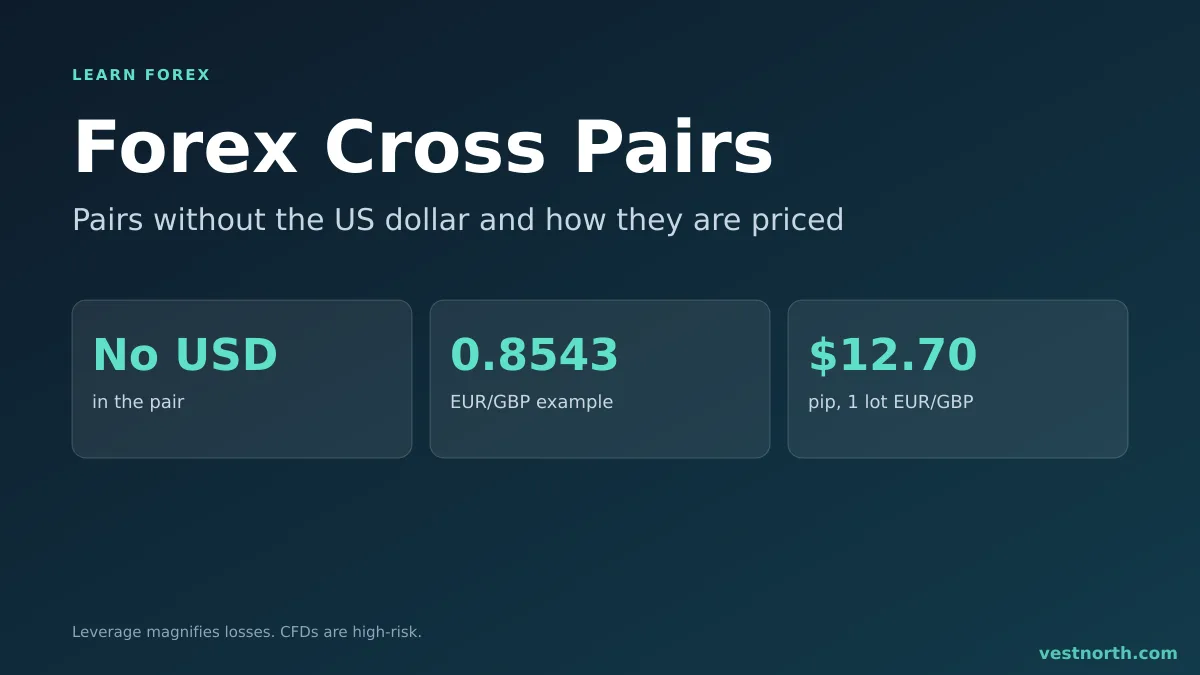
How one cross rate comes from two dollar pairs. Illustration, November 2026.
Which pairs count as crosses
A pair is a cross when neither currency is USD. Brokers sometimes label subsets as “minor” pairs, so the names vary between platforms. The currency pair guide explains base and quote currencies if the terms are new.
| Group | Examples | Contains USD? |
|---|---|---|
| Euro crosses | EUR/GBP, EUR/JPY, EUR/CHF, EUR/AUD | No |
| Sterling crosses | GBP/JPY, GBP/CHF, GBP/AUD | No |
| Commodity crosses | AUD/CAD, AUD/NZD, NZD/CAD | No |
| Yen crosses | EUR/JPY, GBP/JPY, AUD/JPY, CAD/JPY | No |
Exotic pairs are a different category: a major currency against an emerging-market one, such as USD/TRY or EUR/PLN.
How a cross rate is derived
Historically, trading EUR for GBP meant going through the dollar: sell euros for dollars, then buy pounds with the dollars. The cross rate is the result of those two steps.
EUR/GBP = EUR/USD ÷ GBP/USD
Using illustrative prices, if EUR/USD is 1.0850 and GBP/USD is 1.2700:
1.0850 ÷ 1.2700 = 0.8543
So one euro buys about 0.8543 pounds. For yen crosses, multiply: EUR/JPY = EUR/USD × USD/JPY. With EUR/USD at 1.0850 and USD/JPY at 150.00, EUR/JPY is 162.75.
Brokers quote the cross directly with its own bid and ask, so you do not calculate it, but the formula explains why a cross moves when either dollar leg moves.
Why a dollar move can shift a cross
Suppose the dollar weakens broadly. EUR/USD rises from 1.0850 to 1.0900 and GBP/USD rises from 1.2700 to 1.2760.
- Old EUR/GBP: 1.0850 ÷ 1.2700 = 0.8543
- New EUR/GBP: 1.0900 ÷ 1.2760 = 0.8542
Both legs rose, yet the cross hardly changed. If only the euro leg had risen, EUR/GBP would have gone up. A cross measures the difference between two currencies’ moves. That is why traders use crosses to isolate a view on two economies without a dollar position, and why the correlation between pairs matters if you already hold several dollar trades.
Pip value on a cross pair
On any pair, a pip is paid in the quote currency, the second one in the name. For a cross, that is rarely your account currency, so it needs converting.
Worked example, illustrative prices: trade 1 lot (100,000 units) of EUR/GBP with a USD account.
- Pip size is 0.0001. On 1 lot: 0.0001 × 100,000 = 10 GBP per pip.
- Convert to USD at GBP/USD 1.2700: 10 × 1.2700 = $12.70 per pip.
For yen crosses the pip is 0.01. On 1 lot of EUR/JPY, one pip is 0.01 × 100,000 = 1,000 JPY. At USD/JPY 150.00, that is about $6.67.
Because the conversion rate moves, the dollar value of a pip on a cross changes slightly over time, unlike EUR/USD with a USD account. Most platforms show the current figure in the order window. The pip value guide and the lot size guide cover the method in more detail.
Spreads and costs
Spreads on crosses are set by each broker and vary by pair and time of day. Some crosses trade with lower volume than the most active dollar pairs, so a wider spread than EUR/USD is common, though not guaranteed. Check the live spread on your platform at the time you trade.
Cost matters most to short-term trades. A 3-pip spread on a trade with a 30-pip stop is 10% of the risked distance before price moves at all. The spread guide and spread versus commission show how to compare costs between accounts.
Volatility and sizing
Some crosses, especially those involving the pound or the yen, can move many pips in a session. A wide stop on a volatile cross needs a smaller position to keep risk fixed:
- Account: $5,000, risk 1% = $50.
- Stop distance: 80 pips on GBP/JPY.
- Pip value per lot: about $6.67 at USD/JPY 150.00.
- Position: $50 ÷ (80 × $6.67) = about 0.09 lot.
Check pair volatility with average true range before you choose a size. See position sizing for the full steps.
Common mistakes with crosses
- Assuming the dollar is irrelevant. Both legs still react to it.
- Doubling risk without noticing. Long EUR/JPY and long EUR/USD both depend on euro strength. Two trades may be one bet.
- Ignoring the conversion in pip value. A pip on a cross is not a fixed dollar amount.
- Trading illiquid crosses at off-hours. Spreads can widen sharply.
- Reading the cross chart alone. Look at the two dollar legs to see which currency is moving.
Bottom line
A cross pair is any pair without the US dollar, and its price is the ratio of two dollar rates. That makes pip value, spread and risk slightly harder to read than on a dollar pair, but the same sizing method works once you convert the pip into your account currency. Check the live spread and pip value before every trade. Leveraged trading can lose money quickly, so only risk what you can afford to lose.
Frequently asked questions
What is a cross currency pair?
It is a forex pair that does not contain the US dollar, such as EUR/GBP, EUR/JPY or AUD/NZD. Its price comes from the two currencies' values against the dollar.
How is a cross rate calculated?
Divide one currency's dollar rate by the other's. EUR/GBP equals EUR/USD divided by GBP/USD. If EUR/USD is 1.0850 and GBP/USD is 1.2700, EUR/GBP is about 0.8543.
Are cross pairs more expensive to trade?
Often the quoted spread is wider than on the most liquid dollar pairs, but it depends on the pair, the broker and the time of day. Compare spreads on your own platform.
What is the pip value on a cross pair?
A pip is paid in the second currency of the pair, then converted to your account currency. On EUR/GBP, one pip on 1 lot is 10 GBP before conversion to dollars or another currency.
Which pairs are cross pairs?
Any pair without USD, for example EUR/JPY, GBP/JPY, EUR/CHF, AUD/CAD and NZD/JPY. Pairs with USD are the majors or exotics.
Are cross pairs the same as exotic pairs?
No. A cross pair is defined by lacking USD. Exotic pairs pair a major currency with an emerging-market currency and may include USD, as USD/TRY does.
Why does a cross pair move when neither currency is the dollar?
Because both currencies react to their own economies and to dollar moves. A dollar swing can push each leg by a different amount, which changes the cross.