Forex Weekend Risk: Gaps, Rollover Charges and Whether to Hold Trades Over the Weekend
Short answer: Holding a forex trade over the weekend adds three risks. Price can gap between the Friday close and the Sunday open, spreads are often wider right after the reopen, and the rollover swap applies to positions still open at the daily cut-off. A normal stop loss does not guarantee its price in a gap. Traders who do not want this risk close positions before the weekend or use smaller sizes.
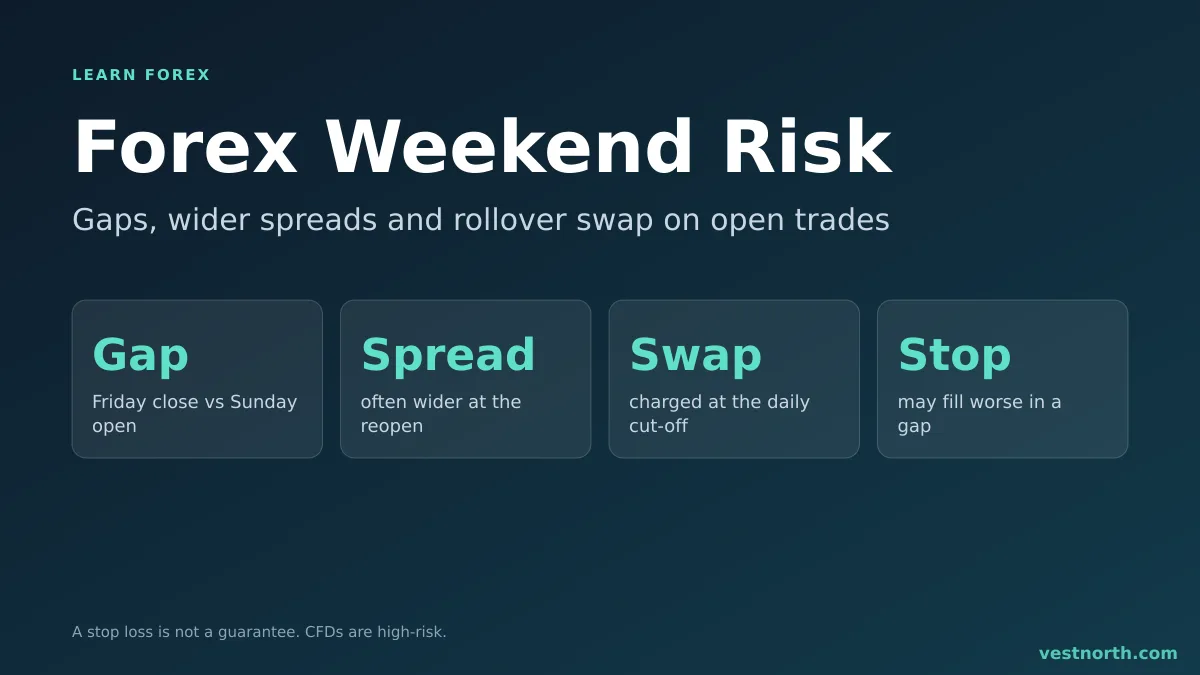
The three weekend risks in one picture. Illustration, November 2026.
When the market is closed
Spot forex trades around the clock on weekdays, because the main centres in Asia, Europe and North America open one after another. It closes for the weekend: roughly from Friday afternoon to Sunday evening in New York. The exact times vary by broker and instrument, so read your broker’s trading hours. Many brokers tie their daily cut-off to the New York close. See forex trading sessions.
While the market is shut, news keeps arriving. Elections, central bank comments, wars and other events do not wait for Monday. Your platform is closed, but the world is not.
Risk 1: the gap
When the market reopens, the first price can differ from the Friday close. That difference is a gap. In the major pairs most weekends produce a small gap or none. After big news, the gap can be large.
The key problem is the stop loss. A standard stop becomes a market order when price touches it. If price jumps past your stop, the order fills at the next available price, which is worse than the level you set. This is a form of slippage. Some brokers offer guaranteed stop-loss orders that fill at the set price. They may cost extra, are not offered on every instrument, and have conditions, so read the terms.
Risk 2: wider spreads at the open
The first minutes after the reopen have few participants, so liquidity is thin. Many brokers show wider spreads for a time, and your stop or entry can trigger on the wider price. The same thing happens around the daily rollover. See spread widening around news for how this works. How wide and for how long depends on the broker and pair, so check your own platform instead of assuming.
Risk 3: rollover and swap
Positions still open at the daily cut-off are rolled to the next value date, and a swap is credited or debited. What rollover is in forex covers the mechanism, and what a swap is explains the amount. Because spot forex settles two business days later, one weekday’s roll covers the weekend as well. Many brokers apply a triple swap on one weekday for that reason, often Wednesday, but the day and rule can differ by broker and by instrument. The broker’s contract specifications are the place to check.
For a position held over a weekend, the cost shows up as the extra swap on that one day, not as a separate weekend fee.
A worked example
These are made-up prices on AUD/USD to show the arithmetic. It is not a real trade.
- You buy 0.10 lot of AUD/USD at 0.6600 on Friday with a stop loss at 0.6550, 50 pips below. At 0.10 lot, one pip is about $1, so the planned risk is about $50.
- Over the weekend, unexpected news hits the Australian dollar. The market reopens at 0.6510, a gap of 90 pips below the Friday entry.
- Price has jumped past the stop, so the stop fills at the first available price, 0.6510.
- The loss is 90 pips, about $90, not the planned $50. That is 1.8 times the intended risk.
Gaps this large are uncommon in major pairs, but the example shows the point: the loss you plan with a stop loss is a target, not a promise. The pip value guide shows how to work out the dollar amounts.
How traders reduce weekend risk
- Close before the weekend. The simplest way to avoid the gap. Many day traders do this as a rule.
- Cut the size. If you hold, use a smaller position so a gap does not damage the account. See position sizing.
- Check the calendar. Look for events scheduled just before or after the weekend on the economic calendar.
- Know your swap. Look up the swap for your pair and direction, and the day of the triple swap, before holding.
- Allow for wider spreads. Do not enter right at the reopen unless your plan expects it.
- Ask about guaranteed stops. If your broker offers them, read the cost and conditions.
Bottom line
The weekend adds a gap risk that a stop loss cannot remove, and thin trading at the reopen can widen spreads. Holding also brings rollover charges. If you hold through the weekend, use a smaller size and check the news calendar and your broker’s swap and trading hours first. If you cannot accept a larger-than-planned loss, close before the weekend. Only risk money you can afford to lose. CFDs are complex, high-risk instruments.
Frequently asked questions
Is it risky to hold forex trades over the weekend?
It can be. The market closes for the weekend, and news can arrive while you cannot trade. Price may reopen at a different level, so a stop loss can fill worse than its set price.
What is a weekend gap?
It is the difference between the Friday closing price and the Sunday opening price. If price reopens beyond your stop loss, the stop usually fills at the first available price, which can be worse than the stop level.
Does a stop loss protect me from a weekend gap?
Only partly. A normal stop becomes a market order once price reaches it, so it can fill at the gap price. Some brokers offer guaranteed stops, which may cost extra and have conditions. Check your broker's terms.
Will I pay swap for holding over the weekend?
Swap is charged on positions open at the daily rollover. Many brokers apply a triple swap on one day to cover the weekend, often Wednesday, but this varies by broker and instrument. Check your broker's specifications.
Do spreads widen at the weekend open?
Often, yes. Liquidity is thin right after the market reopens, so many brokers show wider spreads for a short time. How wide depends on the broker and the pair.
When does the forex market close and reopen?
Spot forex closes on Friday afternoon New York time and reopens on Sunday evening New York time, which is Monday morning in Asia and Australia. Your broker's trading hours show the exact times for each instrument.