What Is an Inverted Hammer Candle in Forex? Rules, Example and Failures
Short answer: An inverted hammer is a candle with a small body near the low and a long upper wick, at least about twice the body, that forms after a fall. It shows buyers pushed price up during the candle but could not hold the gains. It is a possible bullish reversal clue that most traders want confirmed by the next candle before acting. It is the same shape as a shooting star, and only its place after a fall gives it the name.
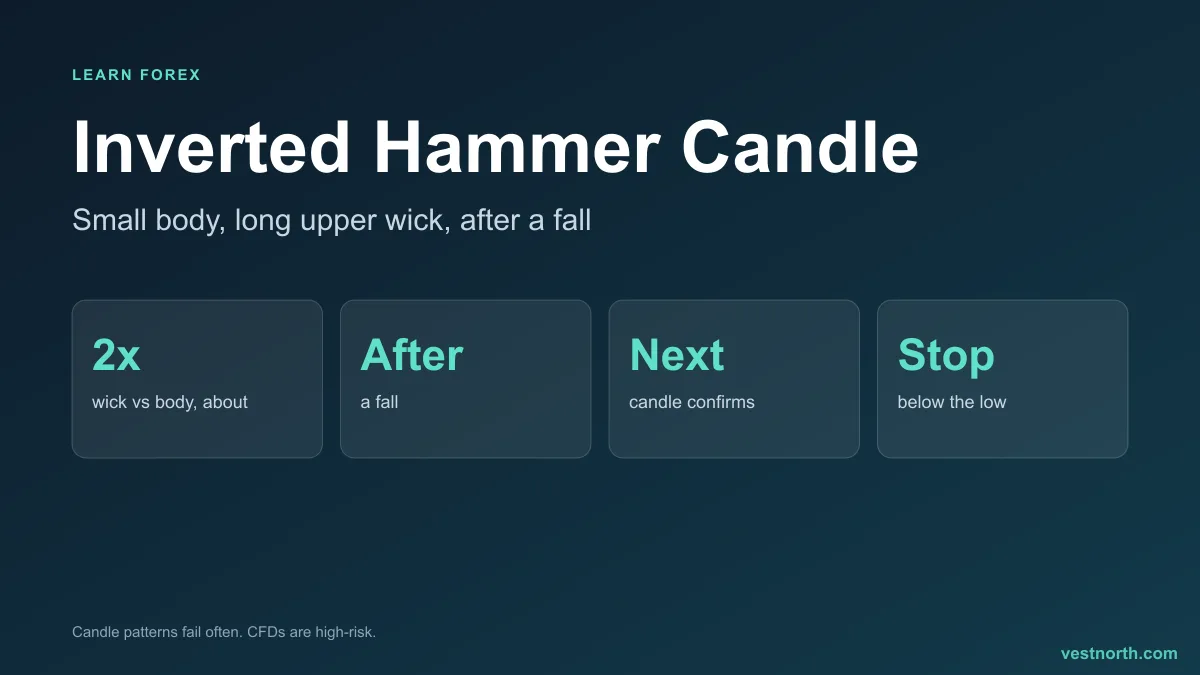
Anatomy of an inverted hammer. Illustration, November 2026.
What an inverted hammer looks like
A candle has a body (open to close) and wicks (the high and low reached). An inverted hammer has three features:
- A small body in the lower part of the candle’s range.
- An upper wick about two or more times the size of the body.
- Little or no lower wick.
It looks like a hammer turned upside down, hence the name. For how bodies and wicks are read in general, see candlestick basics.
What the candle says
Within the candle, buyers pushed price well above the open. Sellers then drove it back toward the open or lower. On its own that sounds bearish, and it is the reason this pattern is weaker than the regular hammer. The bullish reading comes from the fall that came before. After a decline, any sign that buyers are willing to bid is the first break in a run of sellers dominating.
That is why the next candle matters. If it closes above the inverted hammer’s high, buyers have followed through. If it trades below the low, the attempt failed.
Inverted hammer, hammer and shooting star
| Candle | Shape | Where | Typical reading |
|---|---|---|---|
| Inverted hammer | Small body low, long upper wick | After a fall | Possible bullish reversal, needs confirmation |
| Shooting star | Same shape | After a rise | Possible bearish reversal |
| Hammer | Small body high, long lower wick | After a fall | Possible bullish reversal |
| Pin bar | Small body, one long tail | Either way | Rejection of a level |
Compared with the hammer, the inverted hammer closes near its low. That is why it has a reputation as the less convincing of the two.
How to trade an inverted hammer
There is no single correct method. This is a common outline:
- Context. The candle forms after a clear fall, ideally at support or at the end of a pullback inside an uptrend.
- Close. Wait for the candle to close before judging it.
- Confirmation. Wait for the next candle to close above the inverted hammer’s high. This gives a later entry and fewer false signals.
- Entry. Buy above the inverted hammer’s high, or at the close of the confirming candle.
- Stop. Place it below the low of the inverted hammer, with a buffer for the spread. A break of the low means the signal failed.
- Target. The next resistance level, or a multiple of the risk. See the risk-reward ratio.
Worked example (illustrative figures)
On a 4-hour AUD/USD chart, price falls into support near 0.6500. An inverted hammer prints with a low of 0.6492, a high of 0.6538 and a close of 0.6497. The next candle closes at 0.6541, above the high.
| Item | Level | Distance |
|---|---|---|
| Entry (confirming close) | 0.6541 | |
| Stop (below inverted hammer low, minus 2 pips) | 0.6490 | 51 pips |
| Target | 0.6643 | 102 pips |
| Reward to risk | 2 to 1 |
With a 2,000 USD account risking 1% (20 USD), a 51-pip stop allows about 0.39 USD per pip. Use the lot size calculator and position sizing to turn that into a lot size. If the stop is wider than your risk limit allows, skipping the trade is a valid choice. The levels are made up for the example and are not a signal.
Waiting for the confirming close meant buying 3 pips above the inverted hammer’s high of 0.6538. That small cost removes the trades where the next candle falls instead.
Why inverted hammers fail
- No support. Without a level or a prior fall, the wick tells you little.
- Downtrend continues. In a strong decline the candle can be a pause before sellers push on.
- Weak close. The close near the low means sellers won the candle, which is why confirmation is not optional for most traders.
- Hindsight. Finished charts show the ones that worked. We have no verified statistic for how often an inverted hammer leads to a reversal, so treat success rates quoted online carefully.
- News wicks. A spike during a data release reflects the event, not a level. Check the economic calendar.
Bottom line
An inverted hammer is a small-bodied candle with a long upper wick after a fall. It hints that buyers are trying to turn the market, but the weak close means most traders wait for a confirming candle. Put the stop below its low and size the position from that distance. Expect failures. Only risk money you can afford to lose. CFDs are complex, high-risk instruments.
Frequently asked questions
What is an inverted hammer in forex?
An inverted hammer is a single candle with a small body near the bottom of its range and an upper wick at least about twice the body. It appears after a fall and is read as a possible bullish reversal clue.
What is the difference between an inverted hammer and a shooting star?
The shape is the same. After a fall it is called an inverted hammer and read as possibly bullish. After a rise it is called a shooting star and read as possibly bearish.
Is an inverted hammer bullish or bearish?
It is read as a possible bullish reversal because buyers pushed price up during the candle. The long upper wick also shows sellers pushed it back, so most traders want a confirming candle before acting.
Why does an inverted hammer need confirmation?
The candle closed near its low, so sellers still controlled the close. Waiting for the next candle to close above the inverted hammer's high shows that buyers followed through.
What is the difference between a hammer and an inverted hammer?
A hammer has a long lower wick, showing price was pushed down and recovered within the candle. An inverted hammer has a long upper wick, showing buyers tried to push price up but did not hold the move.
Where does the stop loss go on an inverted hammer trade?
Usually just below the low of the inverted hammer, because a break of that low means the attempt to turn failed. Size the position from that distance.