Dragonfly and Gravestone Doji in Forex: How to Read the Long-Wick Doji
Short answer: A dragonfly doji has its open, high and close at about the same price and a long lower wick. A gravestone doji is the mirror image, with open, low and close together and a long upper wick. Both show a failed push in one direction. Neither is a trade signal until the next candle confirms it.
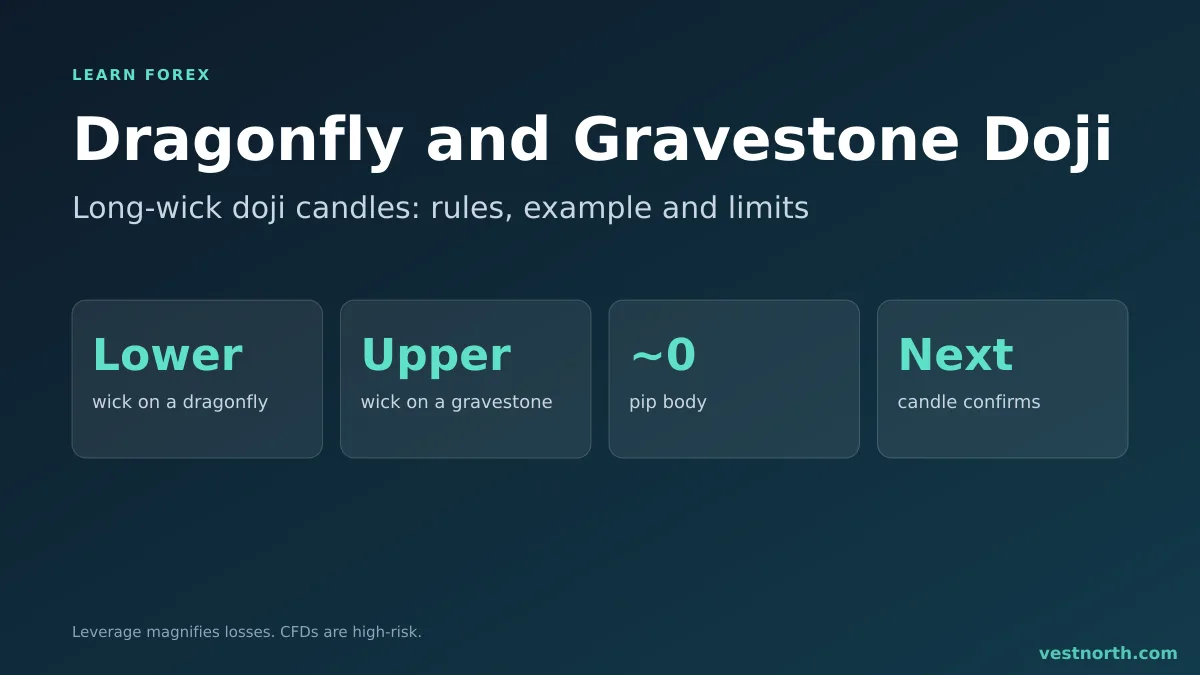
The two shapes side by side. Illustration, November 2026.
How the two candles are built
Both are variations of the standard doji candle, where the open and close are equal or nearly so. What separates them is where the open and close sit inside the candle’s range.
| Feature | Dragonfly doji | Gravestone doji |
|---|---|---|
| Open and close | At or near the high | At or near the low |
| Long wick | Lower | Upper |
| Other wick | None or tiny | None or tiny |
| What happened | Price fell, then recovered to the open | Price rose, then fell back to the open |
| Usual reading | Possible bullish turn after a decline | Possible bearish turn after an advance |
“Equal” is loose in practice. On a 1-hour EUR/USD candle that spans 30 pips, an open and close 1 pip apart still count. If the body is 8 or 10 pips, you are looking at a hammer or a shooting star instead.
What a dragonfly says about the session
Picture a 1-hour candle. Sellers dominate early and drive price far below the open. Later buyers take over and carry price all the way back. By the close, nothing has changed on the surface, but the low is now a level where sellers ran out of strength for that hour.
The gravestone tells the same story upside down. Buyers lift price well above the open, then sellers push it back to where the hour began.
That is the whole idea. The wick marks a rejected price. It does not tell you what the next hour will do.
Worked example on EUR/USD
All prices are illustrative, not a forecast.
After several falling candles, a 1-hour candle opens at 1.0850, trades up to 1.0852, drops to 1.0820 and closes at 1.0851.
- Range: 32 pips (1.0820 to 1.0852).
- Body: 1 pip (1.0850 to 1.0851).
- Lower wick: 30 pips.
That is a dragonfly. A trader who waits for confirmation does not buy yet. The next candle closes at 1.0858, above the dragonfly’s high, so the trader buys at 1.0858.
The stop goes below the wick low with a small buffer for the spread: 1.0814, which is 44 pips from entry. With a $5,000 account risking 1% ($50), the pip value needed is $50 ÷ 44 = about $1.14. On EUR/USD with a USD account, 0.11 lot is about $1.10 per pip, so a stop-out costs roughly $48. See the position sizing guide for the method and risk per trade for the 1% figure.
A gravestone works the same way mirrored. Suppose a candle opens at 1.0900, reaches 1.0932, falls to 1.0899 and closes at 1.0901. The upper wick is 31 pips. A trader who waits for the next candle to close below 1.0899 might sell, with the stop above 1.0932 plus a buffer.
Confirmation and what counts
Because the doji itself has no direction, traders ask for a second piece of evidence:
- The next candle closes past the doji’s other end. For a dragonfly, above its high. For a gravestone, below its low.
- The candle forms at a known level. A dragonfly at a prior low or at support carries more information than one in empty space.
- The trend before it was clear. A doji after a straight run says more than one after a sideways drift.
Waiting costs pips. In the example above, the confirmed entry is 7 pips above the dragonfly’s high. Entering at the doji’s close would have given a better price, but with no evidence that the wick means anything.
When the signal fails
- In a strong trend. A dragonfly in a falling market can be a pause. Price may revisit the low in the next candle and keep falling.
- At the weekly open and around data. Wide spreads and sudden moves create long wicks that reflect liquidity, not a shift in sentiment. See news trading and the economic calendar.
- Very small timeframes. On a 1-minute chart, dojis appear all day. Most mean nothing.
- Tiny wicks. A wick of 3 pips on a pair that moves 80 pips a day is not a rejection of anything.
- No stop. The wick low is a natural stop level. If it is so far away that the position size becomes tiny, the setup may not fit your account.
Compare the wick to the pair’s recent range with average true range. A wick that is a large share of the usual daily range is more notable than one that is not.
We have not backtested these patterns and publish no win rate. If you want a figure, test the rules on past charts on a demo account and include costs.
Checklist before acting
- Is there a clear move into the candle?
- Is the body close to zero compared with the wick?
- Is the wick large relative to recent candles?
- Did the next candle close past the doji’s far end?
- Where is the stop, and does the position size keep the loss within your limit?
- Does the spread leave enough room?
A “no” on any of these is a valid reason to skip.
Bottom line
The dragonfly and gravestone doji each show one rejected price level inside a single candle. They are worth noticing at support, resistance or after a clear move, and worth ignoring most other times. Wait for the next close, size the stop beyond the wick, and treat the pattern as one input beside trend and levels. Leveraged trading can lose money quickly, so only risk what you can afford to lose.
Frequently asked questions
What is a dragonfly doji in forex?
It is a candle where the open, high and close sit at or near the same price and the low is far below. The long lower wick shows sellers pushed price down but buyers brought it back to the open.
What is a gravestone doji?
It is the opposite shape. The open, low and close sit together near the bottom and a long upper wick reaches well above them. Buyers pushed up but sellers returned price to the open.
Is a dragonfly doji bullish?
It can hint at a turn after a decline, but the candle alone is not a buy signal. Many traders wait for the next candle to close above the dragonfly's high before acting.
Is a gravestone doji bearish?
It can hint at a turn after an advance. The same caution applies: the next candle has to confirm, for example by closing below the gravestone's low.
How is a dragonfly doji different from a hammer?
A hammer has a small real body near the top of the candle. A dragonfly has almost no body, so its open and close are nearly equal. The context rules are the same.
Where should the stop loss go?
A common placement is just beyond the long wick: below the dragonfly's low or above the gravestone's high, with a few pips added for the spread.
Do these patterns work on every timeframe?
They appear on all of them, but on very short timeframes spread and noise make them frequent and unreliable. Higher timeframes produce fewer, more meaningful candles.