UK Inflation Rises to 3.6% in October 2026: What the ONS Reported
Risk warning: CFDs are complex instruments and come with a high risk of losing money rapidly due to leverage. Most retail investor accounts lose money when trading CFDs. Consider whether you understand how CFDs work and whether you can afford to take the high risk of losing your money. Nothing on this site is financial advice.
Short answer: The ONS reported on 18 November that UK CPI inflation was 3.6% in the 12 months to October 2026, up from 3.5% in September (ONS). Core CPI, which leaves out energy, food, alcohol and tobacco, was 2.8%. Pound pairs are where traders usually watch inflation data first, and spreads often widen around the release.
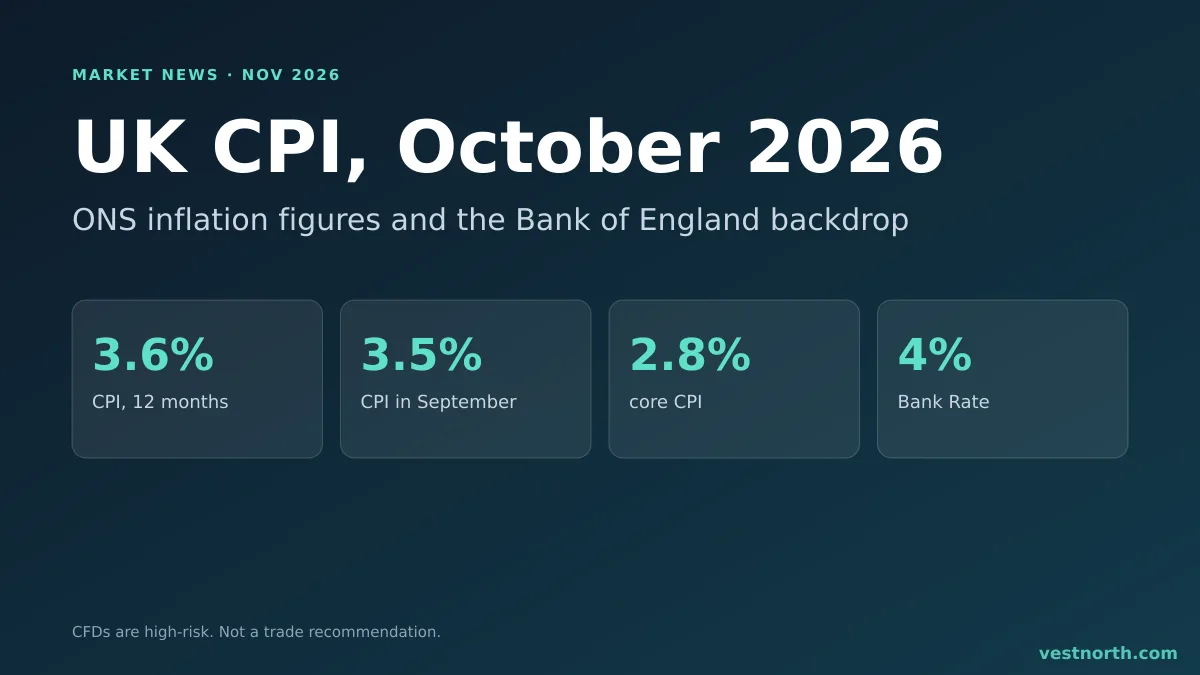
Figures from the ONS October 2026 CPI bulletin and the Bank of England, November 2026.
What the ONS reported
| Measure | 12 months to October 2026 | Note |
|---|---|---|
| CPI | 3.6% | 3.5% in September |
| CPIH (includes owner occupiers’ housing costs) | 3.7% | 3.6% in September |
| Core CPI | 2.8% | Little changed from September |
| RPI | 4.2% | |
| Food and non-alcoholic beverages | 0.8% | 1.2% in September |
The ONS says transport, particularly motor fuels, gave the largest upward contribution to the annual rate. Restaurants and hotels was the largest offsetting downward contribution. The next release is listed for 16 December 2026.
We could not retrieve the full bulletin, so monthly changes and other sub-categories are left out rather than guessed.
How to read the headline and core figures together
Headline CPI counts everything in the basket, so a swing in fuel prices shows up straight away. Core CPI strips out energy, food, alcohol and tobacco, which are the most volatile items. In October the two pointed different ways in level: 3.6% for the headline against 2.8% for core, a gap of 0.8 percentage points. The ONS puts the largest upward contribution in transport, particularly motor fuels, which is the kind of item core leaves out.
The ONS bulletin also describes motor fuel inflation as at its highest since July 2022, and gives the average unleaded price as 174.7 pence per litre in October. Food moved the other way: the annual rate for food and non-alcoholic beverages slowed to 0.8% from 1.2%.
Central banks watch both measures, and the Bank of England’s own November report is where its reading of them is set out (Bank of England report). The ONS release does not say what the Bank will do next.
The Bank of England backdrop
The release landed two weeks after the Bank of England’s decision. At the meeting ending 4 November 2026 the Monetary Policy Committee voted 8-1 to raise Bank Rate by 0.25 percentage points to 4%, with one member preferring a 0.5 point rise to 4.25% (Bank of England).
The committee said the inflationary pressure in the pipeline was now enough to warrant an increase. It also said inflation is expected to rise to around 5% by the middle of next year, and that monetary policy is not on a pre-set path. Those are the committee’s statements, not ours. The next decision is listed for 17 December 2026.
An inflation print matters to the pound because it feeds expectations about that path. A figure that differs from what the market had priced can move GBP/USD and EUR/GBP.
Market reaction
We could not confirm from a source we can quote how sterling, gilts or gold moved after the 07:00 release, so we do not describe the move. Check your own platform’s chart and your broker’s news feed for that.
What it means for a retail trader
- Spreads can widen. The gap between bid and ask can stretch for seconds around a release. Why spreads widen around news puts figures on the cost.
- Slippage can rise. A market order may fill away from the price you saw, and a stop-loss can fill beyond its level when price jumps. What is slippage explains how.
- Margin rules vary. Some brokers raise margin requirements or limit trading around events. Read the terms before the release, not during it. Margin vs leverage covers the basics.
- Know the calendar. The economic calendar guide shows how to read release times in your platform’s server time.
Many traders reduce size or stay flat around major releases. Whether to trade them is your decision, and this brief suggests neither choice.
A checklist before the next release
The ONS lists the next CPI release for 16 December 2026, and the Bank of England lists its next decision for 17 December, one day later. Traders who hold positions through those dates may want to check a few things beforehand:
- The release time in your platform’s server time, not your local clock.
- Your broker’s stated rules on margin and order handling during news periods.
- How much of your margin a sudden gap against a position would use. The margin call and stop out guide shows the levels brokers commonly state.
- Whether any stop-loss orders sit where a fast move could skip past them.
Bottom line
UK inflation edged up to 3.6% in October, with fuel the main upward push and core inflation steady at 2.8%. The Bank of England raised Bank Rate to 4% on 4 November and said policy is not on a pre-set path. Expect wider spreads and slippage around releases like this, know your broker’s margin rules, and only trade with money you can afford to lose. CFDs and margin forex are high risk.
Frequently asked questions
What was UK CPI inflation in October 2026?
The ONS reported that CPI rose 3.6% in the 12 months to October 2026, up from 3.5% in September. CPIH, which includes owner occupiers' housing costs, rose 3.7%.
What drove the rise?
The ONS says transport, particularly motor fuels, made the largest upward contribution. Restaurants and hotels was the largest offsetting downward contribution.
What is core CPI?
Core CPI leaves out energy, food, alcohol and tobacco. The ONS reported 2.8% for October 2026, little changed from September.
What did the Bank of England decide in November 2026?
At its meeting ending 4 November 2026 the Monetary Policy Committee voted 8-1 to raise Bank Rate by 0.25 percentage points to 4%. One member voted for a 0.5 point rise.
When is the next UK CPI release?
The ONS lists the next release as 16 December 2026.
Is this a forecast for the pound?
No. It reports published figures and what officials said. It gives no trade calls or price targets.
Sources
- ONS: Consumer price inflation, UK: October 2026
- Bank of England: Monetary Policy Summary and minutes, November 2026
- Bank of England: Monetary Policy Report, November 2026
Sources checked on November 19, 2026. Broker terms change often: confirm the current conditions on the broker's own site before you open an account.