Elliott Wave Theory in Forex: The Basic Pattern, Its Three Rules and Its Limits
Short answer: Elliott wave theory says a trend moves in five waves with the trend (numbered 1 to 5) followed by three waves against it (lettered A, B, C). Three rules define a valid five-wave move: wave 2 cannot retrace more than 100% of wave 1, wave 3 cannot be the shortest of waves 1, 3 and 5, and wave 4 cannot overlap wave 1. Counting waves is subjective, so two traders can read the same chart differently.
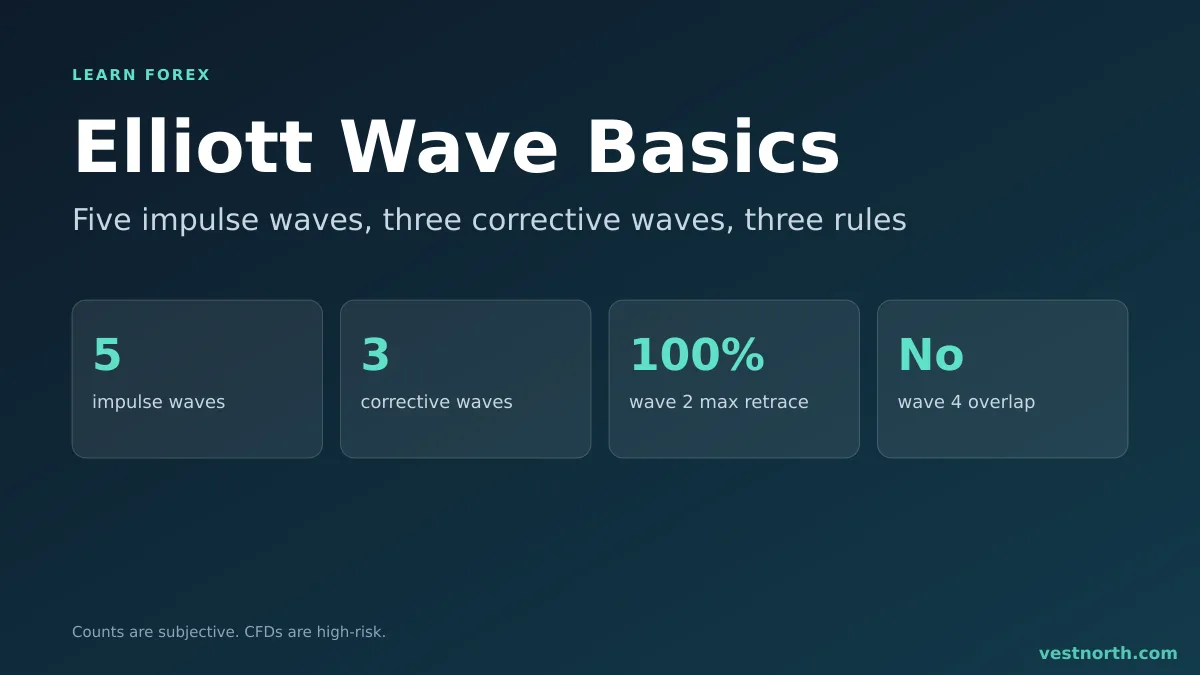
The five-wave and three-wave structure. Illustration, November 2026.
The basic pattern
| Phase | Waves | Direction |
|---|---|---|
| Impulse | 1, 3, 5 | With the main trend |
| Impulse pauses | 2, 4 | Against the main trend |
| Correction | A, C | Against the main trend |
| Correction pause | B | With the main trend |
Waves 1, 3 and 5 are the pushes, and 2 and 4 are pullbacks within the trend. After wave 5, the theory expects a correction of three waves, A-B-C. Taken together, five waves up and three waves down form one larger cycle, and the same shape is said to repeat inside each wave on a lower time frame. That nesting is the part that makes the method flexible and also hard to test.
The three rules
- Wave 2 never retraces more than 100% of wave 1. If price falls below the start of wave 1, it was not wave 2.
- Wave 3 is never the shortest of the three impulse waves (1, 3, 5). It is often the longest, but it only has to avoid being the shortest.
- Wave 4 does not overlap the price territory of wave 1 in a standard impulse.
These rules matter because they give an invalidation point. When one is broken, the count is dropped, which is one of the few objective parts of the method.
A worked example
These are made-up prices to show the arithmetic. It is not a real trade.
- EUR/USD rises from 1.0800 (start of wave 1) to 1.0900 (end of wave 1), 100 pips.
- Wave 2 pulls back to 1.0840, a retracement of 60 pips, or 60% of wave 1. That is below 100%, so rule 1 holds.
- Wave 3 rises to 1.1050, a 210-pip leg. It is longer than wave 1, so rule 2 is on track.
- Wave 4 pulls back to 1.0960. It stays above 1.0900, the top of wave 1, so rule 3 holds.
A trader who believes wave 5 is starting might buy near 1.0960 with a stop loss just below 1.0900, the level where the count fails. That is a 60-pip stop. A 1% risk on a $1,000 account ($10) gives about 0.02 lot at roughly $0.17 per pip. If price falls below 1.0900, the count is wrong and the stop does its job.
Why counts are subjective
- Where a wave starts. Whether a small pullback is a wave or noise is a choice.
- Alternate counts. The same swings can fit more than one valid labelling until later candles rule some out.
- Extensions and complex corrections. Waves can extend and corrections come in many forms, such as zigzags, flats and triangles, so a count can be adjusted after the fact.
- Hindsight. Counts look clean on a finished chart. The live edge of the chart is where they are hardest to make.
We know of no verified study that shows Elliott counts predict forex prices, so we do not quote one. Many traders use the theory to organise a chart, not as a forecast.
How traders combine it with other tools
- Fibonacci retracements to estimate where wave 2 or wave 4 may end.
- Trend trading rules to decide the direction of the larger move.
- Swing highs and swing lows to mark where a wave begins and ends.
Using it in a plan
- Mark the larger trend on a higher time frame first.
- Label waves only from clear swing points.
- Write down the invalidation level before entering.
- Place a stop loss there and size the position from the distance.
- Practise counting on past charts and on a demo account.
Bottom line
Elliott wave theory is a way of labelling a trend as five waves with the trend and three against it, with three rules that tell you when a count is wrong. It is subjective and unproven as a forecasting tool. If you use it, trade the invalidation level, not the count, and put a stop loss on every trade. Only risk money you can afford to lose. CFDs are complex, high-risk instruments.
Frequently asked questions
What is Elliott wave theory?
It is a method of reading charts that says price moves in repeating patterns: five waves in the direction of the main trend (labelled 1 to 5), then three corrective waves against it (labelled A, B and C).
What are the three basic Elliott wave rules?
Wave 2 cannot retrace more than 100% of wave 1. Wave 3 cannot be the shortest of waves 1, 3 and 5. Wave 4 cannot overlap the price area of wave 1 in a standard impulse. If a rule breaks, the count is wrong.
Does Elliott wave work in forex?
It is used by many chartists on forex, but we know of no verified statistics showing it predicts price. The count depends on the person doing it, so treat it as one way to organise a chart, not a forecast.
Why do two traders count the same chart differently?
Where a wave starts and ends is a judgement call, and the same swings can often fit more than one count. Traders resolve it by waiting for the invalidation level.
Do Fibonacci levels belong to Elliott wave?
Many Elliott traders use Fibonacci retracements as guides, for example looking at wave 2 or 4 retracing a portion of the previous wave. They are rules of thumb, not part of the three core rules.
Can a beginner use Elliott wave?
A beginner can learn the structure, but counting live is hard. Practise on past charts and on a demo account, and use a stop loss placed where your count would be wrong.