US PCE Inflation for October 2026: What the BEA Reported
Risk warning: CFDs are complex instruments and come with a high risk of losing money rapidly due to leverage. Most retail investor accounts lose money when trading CFDs. Consider whether you understand how CFDs work and whether you can afford to take the high risk of losing your money. Nothing on this site is financial advice.
Short answer: The Bureau of Economic Analysis (BEA) reported on 25 November that the US PCE price index rose 3.8% in the 12 months to October 2026, and 3.3% excluding food and energy (BEA). Both measures rose 0.3% on the month. PCE is one of the inflation gauges traders watch for clues about US rate expectations, so spreads on dollar pairs and gold often widen around the release.
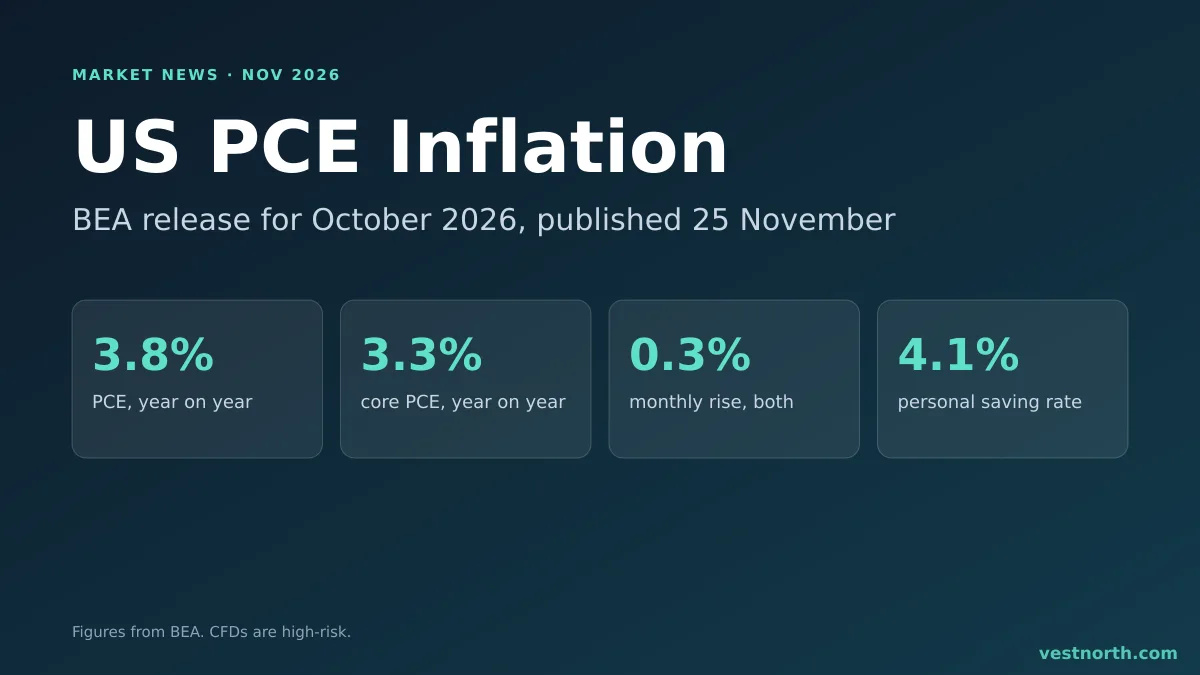
Figures from the BEA release of 25 November 2026 and the Federal Reserve’s October minutes.
What the BEA reported
| Measure | October 2026 | Note |
|---|---|---|
| PCE price index, year on year | 3.8% | Month on month: 0.3% |
| Core PCE (excluding food and energy), year on year | 3.3% | Month on month: 0.3% |
| Personal income | +0.7% | Up $201.8 billion |
| Disposable personal income | +0.8% | Up $200.5 billion |
| Consumer spending (current dollars) | +0.3% | Up $63.8 billion |
| Personal saving rate | 4.1% | Saving of $1.00 trillion |
The BEA says current-dollar spending rose $11.8 billion on goods and $52.1 billion on services. Real spending, which adjusts for prices, fell $5.8 billion, less than 0.1%. The income gain was led by compensation, government benefits and asset income, and the BEA notes that benefits were boosted by one-time payments tied to a Medicare Improvement Fund premium rebate.
Against the previous month
BEA’s September release, published on 29 October, showed the PCE price index up 3.6% from a year earlier and core up 3.1% (BEA). BEA’s later data pages list September headline at 3.7%, so the headline comparison depends on whether you use the original or the revised figure. Against either, core inflation moved up by 0.2 percentage points, from 3.1% to 3.3%.
We could not retrieve the full release text, so detail on individual price categories is left out rather than guessed.
What the Fed said last
The BEA does not set interest rates. The Federal Reserve does, and its minutes of the 27-28 October meeting, published on 18 November, say 10 members agreed to maintain the federal funds target range at 3-3/4 to 4 percent (Federal Reserve). The minutes were written before the October PCE figures existed, so they say nothing about this release.
The Fed’s calendar lists the next FOMC meeting for 8-9 December, and that meeting includes a Summary of Economic Projections. The BLS schedule lists the November employment report for 4 December, four days before the meeting begins.
Market reaction
We could not confirm from a source we can quote how the dollar, euro, yen or gold moved after the 8:30 a.m. Eastern release, so we do not describe the move. Check your own platform’s chart and your broker’s news feed.
What it means for a retail trader
- Spreads can widen. The gap between bid and ask can stretch for seconds around a release. Why spreads widen around news puts figures on the cost.
- Slippage can rise. A market order can fill away from the price you saw, and a stop-loss can fill beyond its level when price jumps. What is slippage explains how.
- Margin rules vary. Some brokers raise margin requirements or restrict trading around events. Read the terms before the release. Margin vs leverage covers the basics.
- Release times. The economic calendar guide shows how to read release times in your platform’s server time.
Dates to check
| Date | Event | Source |
|---|---|---|
| 4 December 2026 | US employment situation, November | BLS schedule |
| 8-9 December 2026 | FOMC meeting with projections | Federal Reserve calendar |
| 23 December 2026 | Personal Income and Outlays, November | BEA schedule |
Dates can change, and the agencies update their calendars as needed. Confirm them on the official pages before you plan around them.
Bottom line
US PCE inflation was 3.8% in October, with core at 3.3% and both up 0.3% on the month. The Fed held its target range at 3-3/4 to 4 percent in October and meets again on 8-9 December. Expect wider spreads and slippage around releases like this, know your broker’s margin rules, and only trade with money you can afford to lose. CFDs and margin forex are high risk.
Frequently asked questions
What was US PCE inflation in October 2026?
The BEA reported that the PCE price index rose 3.8% from October 2025 and 0.3% from September. Excluding food and energy it rose 3.3% from a year earlier and 0.3% on the month.
Why do traders watch PCE?
PCE is an inflation measure published by the BEA. Rate expectations for the US dollar often shift around it, which can move USD pairs and gold.
What did incomes and spending do in October?
Personal income rose $201.8 billion (0.7%) and consumer spending rose $63.8 billion (0.3%). The BEA says real spending fell $5.8 billion, and the saving rate was 4.1%.
What is the Fed's current rate range?
The minutes of the 27-28 October meeting say 10 members agreed to keep the federal funds target range at 3-3/4 to 4 percent.
When is the next PCE release?
The BEA schedule lists Personal Income and Outlays for November 2026 on 23 December 2026. The next FOMC meeting is 8-9 December.
Is this a forecast for the dollar or gold?
No. It reports published figures and what officials said. It gives no trade calls or price targets.
Sources
- BEA: Personal Income and Outlays, October 2026
- BEA: Personal Income and Outlays, September 2026
- Federal Reserve: FOMC minutes, October 27-28, 2026
Sources checked on November 26, 2026. Broker terms change often: confirm the current conditions on the broker's own site before you open an account.