Jupiter Exchange Review 2026: Swap Fees, Perps, Wallets and Risks
Advertiser disclosure: we may earn a commission if you open an account through our links. It does not affect our assessment. How we make money
Risk warning: Crypto-assets are highly volatile and largely unregulated. Leveraged perpetual futures can lose your whole margin within minutes. Exchange balances and self-custody wallets are not covered by deposit insurance or investor compensation schemes. Consider whether you can afford to lose all of the money you put in. Nothing on this site is financial advice.
- Non-custodial: tokens stay in your own Solana wallet
- Swap fees from 0% to 0.5% by pair, shown before you sign
- Perps from 1.1x to 250x on SOL, ETH and wBTC
Jupiter does not accept clients from your country, so we don't link to it here. See other crypto platforms, and always check that a platform is authorised where you live.
People who already hold a Solana wallet and want to swap Solana tokens through one interface, with limit and DCA orders on the same screen
US residents and others in the barred countries, anyone who wants an account they can recover through support, and beginners looking at 250x perps
No regulator and no deposit protection, fake tokens that copy real names, rug pulls, and liquidation that takes all remaining perps collateral
Short answer: Jupiter (jup.ag) is a non-custodial exchange aggregator on Solana. It routes your swap across Raydium, Meteora and more than 100 other liquidity sources and lets you sign the trade in your own wallet. Its default swap fee runs from 0% to 0.5% by pair, its perps go up to 250x, and its Terms bar wallets in the United States and several other countries. Nobody regulates it and nothing protects your deposit if a trade or a token goes wrong.
How this review was made: we read Jupiter’s user docs, developer docs, Terms of Use and published audit list as of October 2026. We have not traded on Jupiter. Fees and parameters change, and Jupiter says the quote shown in the app is what counts.
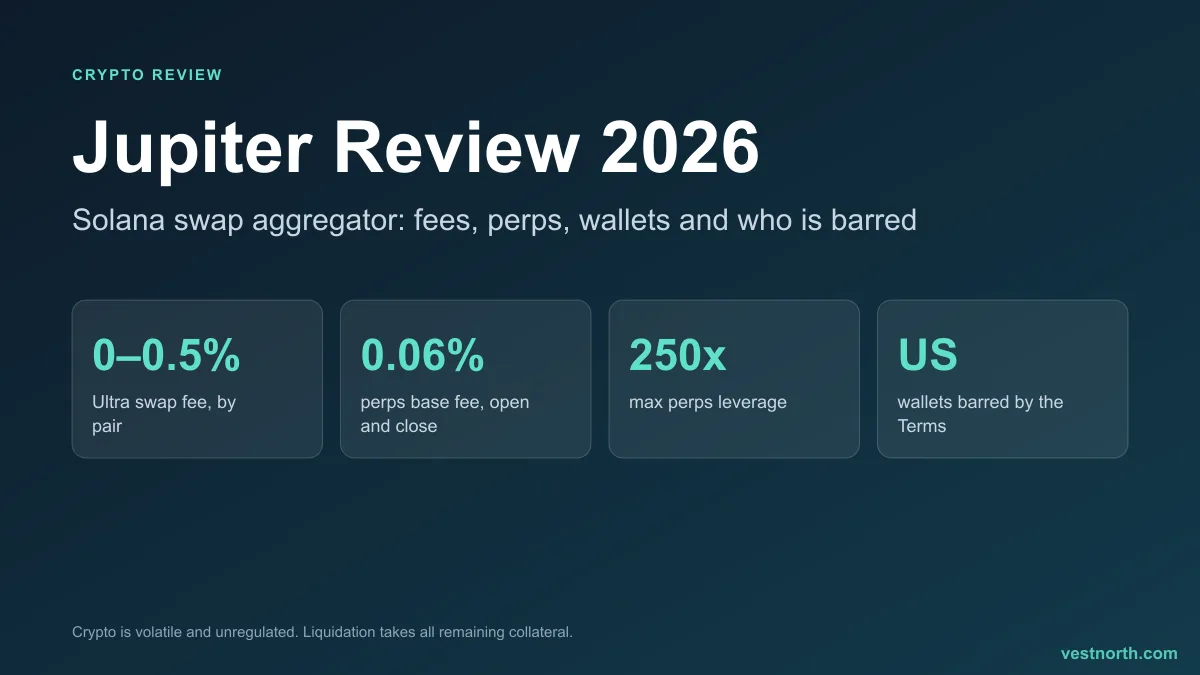 Jupiter in four numbers. Source: Jupiter docs and Terms of Use, October 2026.
Jupiter at a glance
| What it is | Swap aggregator and trading interface on the Solana blockchain |
| Operator named in the Terms | Block Raccoon S.A., Terms governed by the laws of Panama |
| Custody | Non-custodial: assets stay in your own wallet |
| Regulation | None stated. The Terms say it offers no “regulated service” |
| Spot swap fee | Ultra Mode 0% to 0.5% by pair · Manual Mode 0% Jupiter commission |
| Order types | Market swap, limit orders (with take profit and stop loss), DCA orders |
| Perps | SOL, ETH and wBTC against the JLP pool, 1.1x to 250x, plus Beta markets |
| Perps base fee | 0.06% of trade size to open and to close |
| Wallets | Jupiter Wallet, Phantom, Backpack, Ledger, Trezor, Quick Accounts |
| Not available to | US, Singapore, “the Republic of China” and a list of sanctioned or high-risk places (see below) |
Pros
- You keep custody: the Terms say neither the interface nor the protocol holds or controls your digital assets
- Low fees on common pairs: 0.02% on SOL to stablecoin swaps in Ultra Mode, 0% on stable-to-stable
- Manual Mode swaps carry no Jupiter commission, only Solana network fees and any Jito tip
- Fee shown before you sign: the quote includes Jupiter's fee, the network fee and the route
- Published third-party audits for the swap, perps and limit-order programs, with links to each report
- Scam-token warnings (Jupiter Shield) for unverified tokens and tokens with mint or freeze authority
Cons
- No regulator, no compensation scheme and no one who can reverse a confirmed transaction
- Anyone can create a Solana token with any name, so fake copies of real tokens appear in search
- 0.5% fee on tokens less than 24 hours old, the riskiest trades on the platform
- Perps up to 250x, with all remaining collateral taken on liquidation
- Manual Mode has no MEV protection, and Ultra's protection reduces the risk without removing it
- Closed to US wallets and several other countries, with VPN use forbidden by the Terms
Is Jupiter safe and legit?
Short answer: Jupiter is a real Solana interface with open documentation and published audits. It is also an unregulated piece of software. You hold your own keys, which removes the risk of an exchange freezing or losing your balance, and adds the risk that a mistake you sign cannot be undone.
Who runs Jupiter
The Terms of Use describe jup.ag as a website interface “made available by Block Raccoon S.A.” and describe the underlying Jupiter protocol as open-source software deployed by the same company (source). The Terms are governed by the laws of Panama, say the interface is “deemed to be based solely in Panama”, and send disputes to binding arbitration under the London Court of International Arbitration rules, with a class action waiver. A claim must be filed within one year of the dispute arising.
What this means in practice:
- The Terms say the deploying entity “is not offering any sort of securities product or regulated service nor does it hold any user assets on custody.” We found no licence from a financial regulator on any page we read.
- There is no deposit insurance, investor compensation scheme or ombudsman. If you send tokens to a scam contract or get liquidated, Jupiter’s Terms say it cannot cancel or modify your onchain interactions.
- The Terms disclaim any fiduciary duty to users and say information on the interface, including prices, may be inaccurate. You are told to verify it yourself.
Non-custodial: what you gain and what you lose
Section 5 of the Terms says the interface and protocol are “non-custodial in nature, therefore neither holds or controls your digital assets.” Your tokens sit in a wallet you choose, and Jupiter has no access to it. That means no withdrawal queue and no frozen exchange balance. It also means there is no password reset: whoever holds your private key or seed phrase holds your funds. Jupiter’s docs repeat this for its Quick Accounts, embedded wallets you log into with email or a social account: they are non-custodial, the private key can be exported, and “anyone with access to it has full control over your wallet and funds” (source).
Audits and smart-contract risk
Jupiter’s security page lists third-party audits for its main programs (source):
| Program | Auditors listed | Latest review listed |
|---|---|---|
| Swap (v3, v6, JupiterZ RFQ) | Sec3, Offside Labs | Swap v6, October 2025 |
| Jupiter Perpetuals | Offside Labs, OtterSec, Sec3 | February 2024 |
| Limit Order v2 | Offside Labs | April 2024 |
The same page says an audit “is a point-in-time review” that “does not guarantee that a program is free of bugs or that funds cannot be lost.” It also says the perpetuals program has been upgraded since those reports and that the Beta perps markets run on a separate engine (GUM) that the reports do not cover.
Jupiter is transparent about how it works, what it charges and what can go wrong, and its main programs have been audited. It is still unregulated software run by a Panama-law company. Treat every swap as final and every unfamiliar token as a possible scam.
Jupiter fees
Jupiter’s fees come in up to three layers, according to its fee page (source):
- Solana network fees, which go to the blockchain, not to Jupiter, and are paid even if the trade fails.
- Jito tips, only in Manual Mode when you pick Jito or MEV-protect broadcasting.
- Jupiter commission, which depends on the product and, in Ultra Mode, on the pair.
Swap fees in Ultra Mode (the default)
| Pair type | Jupiter fee |
|---|---|
| SOL or stablecoin into JUP, JLP or jupSOL | 0% |
| Liquid staking token to liquid staking token, or stablecoin to stablecoin | 0% |
| Jupiter Lend deposits and redemptions | 0% |
| SOL to stablecoin | 0.02% |
| Liquid staking token to stablecoin | 0.05% |
| All other swaps | 0.1% |
| Buying or selling tokens less than 24 hours old | 0.5% |
Source: Ultra Mode fees. The developer docs show the same schedule in basis points, from 0 to 50 bps (source).
Worked example from those rates: a swap of $1,000 of USDC into a token listed for a week falls under “all other swaps”, so the Jupiter fee is 0.1%, or $1. The same $1,000 into a token launched this morning costs 0.5%, or $5, before network fees, price impact and slippage.
Is Jupiter free? Not quite. Network fees apply to every transaction, even failed ones. Jupiter’s own commission is 0% in Manual Mode and on a short list of Ultra pairs, 0.1% on most other swaps, and up to 0.5% on tokens under 24 hours old. Price impact and slippage come on top and are not fees, but they often cost more on thin tokens (see the section below).
Other spot fees
- Manual Mode market swaps: 0% Jupiter commission. You set slippage and priority fees yourself and pay network fees and any Jito tip.
- Limit orders V2: a base fee of 0.03% on stable or pegged pairs and 0.1% on all other pairs, plus an Ultra routing fee of 0% to 0.5% (source). The older V1 orders charge a flat 0.1%, only when the order executes.
- DCA orders: V1 charges 0.1% flat, V2 charges 0.03% to 0.1% base plus the Ultra routing fee.
- Gasless swaps: if your wallet holds too little SOL, a relayer pays the gas and the swap fee rises by the dollar value of that SOL. Jupiter says it adds no margin, but because the gas is a fixed amount it weighs more on small trades and can reach 10% of the trade at the eligibility limit, which sets a minimum trade size of about $10.
- Jupiter Mobile: swaps placed natively in the mobile app follow a separate fee schedule, so the table above does not apply there.
About our referral link
The button on this page uses a Jupiter swap referral link, and VestNorth may earn a reward if you use it. Jupiter’s developer docs describe an onchain Referral Program in which an integrator sets a referral fee of 50 to 255 bps on Swap API orders, Jupiter takes 20% of that fee, and no separate platform fee applies (source, Referral Program). We could not confirm from Jupiter’s user docs whether a jup.ag link with a referral code changes the fee you pay. The swap form shows a Platform Fee line before you confirm, so compare it with the table above and with the same quote opened without the link.
Slippage, price impact and MEV
A swap quote is an estimate. Three things can make the result worse than the number you saw (source):
- Slippage: the price moves between submitting and confirming. Ultra Mode sets slippage automatically with its Real-Time Slippage Estimator. In Manual Mode you pick 0.5%, 1% or a custom value (source). Too low and trades fail. Too high and you can be filled at a poor price. Our guide to slippage explains the idea with forex examples, and it works the same way on a DEX.
- Price impact: a large trade against a small pool moves the price against you. Jupiter shows the estimate before you confirm, and that figure includes Ultra fees and any gasless surcharge.
- MEV: bots can front-run or “sandwich” pending trades. Ultra Mode sends transactions privately, which Jupiter says “significantly reduces the risk but does not eliminate it.” Manual Mode has no MEV protection.
For thin tokens, Jupiter warns that selling a large position “may not be possible at the expected price, or at all.”
Token scams and rug pulls
Jupiter lists tokens as soon as they can be traded onchain, including newly launched, unverified and bonding-curve tokens. Because creating a Solana token is permissionless, Jupiter warns that anyone can use any name or ticker, “including fake tokens designed to impersonate legitimate projects”, and tells users to verify the contract address before trading (source).
The risks its docs name:
| Risk | What it means for you |
|---|---|
| Fake token | Same name and ticker as a real project, different contract address |
| Mint authority | The creator can create more tokens at any time and dilute holders |
| Freeze authority | The creator can freeze your token account so you cannot sell |
| Rug pull | The creator removes all liquidity, leaving the token untradable |
| Bonding curve | Limited liquidity and higher price impact before the token migrates to a normal pool |
Jupiter Shield flags “Not Verified”, “Low Organic Activity”, “New Listing”, “Has Freeze Authority” and “Has Mint Authority” in the trade widget. Jupiter says these indicators are “informational tools, not guarantees of safety.” A token can show healthy numbers and still go to zero.
A simple routine: copy the contract address from the project’s own official channel, paste it into the search, check the Shield warnings, and buy a small amount first. Skip any token with an active freeze authority unless you understand why it exists.
Jupiter Perps: leverage and liquidation
Jupiter Perps is a perpetual futures exchange on Solana (source). On its SOL, ETH and wBTC markets, traders borrow from the Jupiter Liquidity Pool (JLP), and JLP holders act as counterparty to every trade: when traders win, the pool pays; when they lose, the pool collects. Prices come from oracles (Edge by Chaos Labs as primary, with Chainlink and Pyth as checks and fallback), not an order book.
| Parameter (SOL, ETH, wBTC markets) | Value |
|---|---|
| Leverage range | 1.1x to 250x |
| Minimum collateral | $10 per new position |
| Maximum positions | 6 (one per asset per side) |
| Base fee | 0.06% of trade size, on open and on close |
| Price impact fee | Scales with size; base plus price impact capped at 0.50% of size |
| Borrow fee | Hourly rate on the full position size while it is open |
| Liquidation fee | All remaining collateral |
Fees: Perps fees. Jupiter’s own example: a $10,000 trade pays a $6 base fee (0.06%), and the same rate applies again when you close, before price impact, borrow and network fees.
Beta markets (JUP, HYPE, ZEC and stock-price markets on SpaceX, SanDisk and SK hynix) run on a separate order-book engine called GUM, with USDC collateral, an hourly funding rate between longs and shorts, taker and maker fees, and leverage limits set per market (source).
How liquidation works
A JLP-market position is liquidated when the oracle price reaches its liquidation price. Jupiter’s docs say “all remaining collateral is taken” as a liquidation fee and “you will not receive any portion of your collateral back” (source). The liquidation price also drifts toward the market over time, because borrow fees count against your collateral. Jupiter says this effect is strongest above 10x and on positions held for a long time, and that a position can approach liquidation “even without any price movement.”
Stop losses help but are not guaranteed: if the price moves past your trigger by more than your slippage tolerance, the order may not fill, and in a fast market the position can be liquidated first.
At 250x, a move of well under 1% against you can wipe out the position. Leverage does not change your odds, it changes how fast losses arrive. If you are new, read our guide to leverage and to margin call and stop out first, and keep any perps position small and low-leverage.
Wallets and getting started
You need a Solana wallet to trade on Jupiter. Its docs list Jupiter Wallet (browser extension and mobile), Solana wallets such as Phantom and Backpack, and Ledger and Trezor hardware wallets (source). The Jupiter Mobile app can pair with the website through Magic Scan.
The general flow:
- Set up a Solana wallet and write the seed phrase down offline. Never type it into a website.
- Fund the wallet with SOL or USDC from an exchange or another wallet. Keep a little SOL for network fees, since gasless swaps cost more on small trades.
- Connect the wallet on jup.ag, pick the token pair, and check the rate summary, fee breakdown and route.
- Sign the transaction in your wallet. Once confirmed onchain, it cannot be reversed.
Solana also charges rent, a small SOL deposit to keep each token account open. Jupiter’s Rent Reclaim tool can close empty accounts and return that SOL.
Is Jupiter available in my country?
Jupiter’s Terms of Use contain a “Prohibited Localities” clause. It says Jupiter “does not interact with digital wallets located in, established in, or a resident of” (source):
- the United States
- “the Republic of China” (the official name of Taiwan; we could not confirm whether Jupiter means Taiwan or mainland China)
- Singapore
- Myanmar, Côte d’Ivoire, Cuba, Crimea and Sevastopol, the Democratic Republic of Congo, Iran, Iraq, Libya, Mali, Nicaragua, North Korea, Somalia, Sudan, Syria, Yemen and Zimbabwe
- any other state, country or region subject to sanctions enforced by the United States, the United Kingdom or the European Union
The Terms forbid using a VPN or any other technique to change your IP address or get around the ban, and they let Jupiter limit access for any person or region at any time. Separately, you are responsible for checking whether your own country’s laws allow you to use a DEX. US residents should not use Jupiter.
Jupiter alternatives
| If you want… | Compare |
|---|---|
| Perpetual futures on a different decentralised venue | dYdX review |
| A centralised exchange with fiat deposits and account recovery | Kraken review |
| A regulated account with investor protection | A licensed exchange or broker in your own country |
Bottom line
Jupiter documents its Solana swap costs in detail: fees are published by pair, shown before you sign, and start at 0% on stablecoin pairs and 0.02% on SOL to stablecoins. Your tokens stay in your wallet, and the swap, perps and limit-order programs have published audits.
The trade-offs are just as clear. There is no regulator and no deposit protection, fake tokens and rug pulls are common on Solana, and perps up to 250x can take all of your collateral. The Terms bar wallets in the United States, Singapore and several sanctioned countries.
Our recommendation: suitable for people who already manage a Solana wallet safely and verify every contract address. Beginners should start with small swaps of well-known tokens, stay away from perps until they understand liquidation, and only put in money they can afford to lose.
- Non-custodial: tokens stay in your own Solana wallet
- Swap fees from 0% to 0.5% by pair, shown before you sign
- Perps from 1.1x to 250x on SOL, ETH and wBTC
Jupiter does not accept clients from your country, so we don't link to it here. See other crypto platforms, and always check that a platform is authorised where you live.
Frequently asked questions
Is Jupiter exchange safe?
Jupiter is non-custodial: your tokens stay in your own Solana wallet and its swap, perps and limit-order programs have published third-party audits. It is not regulated, there is no deposit protection, and Jupiter's own docs say an audit does not guarantee that funds cannot be lost.
What are Jupiter's swap fees?
In Ultra Mode, the default, Jupiter charges 0% to 0.5% depending on the pair: 0% on stable-to-stable and some Jupiter tokens, 0.02% on SOL to stablecoins, 0.1% on most other swaps and 0.5% on tokens less than 24 hours old. Manual Mode swaps carry no Jupiter commission. Solana network fees are extra.
Is Jupiter free to use?
Not entirely. Manual Mode market swaps carry no Jupiter commission, but you still pay Solana network fees, and any Jito tip you choose. In Ultra Mode the Jupiter fee is 0% to 0.5% depending on the pair. A $1,000 swap into an established token at 0.1% costs $1 in Jupiter fees.
Can US residents use Jupiter?
No. Jupiter's Terms of Use say it does not interact with digital wallets located in, established in or resident in the United States, and they forbid using a VPN to get around this.
Which company runs Jupiter?
The Terms of Use name Block Raccoon S.A. as the company that makes the jup.ag interface available. The Terms are governed by the laws of Panama, with disputes settled by LCIA arbitration.
Do I need a wallet to use Jupiter?
Yes. You connect a Solana wallet such as Jupiter Wallet, Phantom, Backpack or a Ledger or Trezor hardware wallet. Jupiter also offers Quick Accounts, embedded wallets you log into with email or a social account, and says you can export the private key.
What leverage does Jupiter Perps offer?
On the SOL, ETH and wBTC markets, leverage runs from 1.1x to 250x, with a $10 minimum collateral per new position and a 0.06% base fee to open and to close. If a position is liquidated, all remaining collateral is taken.
Does Jupiter have a referral program?
Jupiter runs an onchain Referral Program for developers who integrate its Swap API, with integrator fees of 50 to 255 bps of which Jupiter takes 20%. VestNorth may earn a reward if you use our link. Check the Platform Fee line in the quote before you confirm a swap.
Sources
- Jupiter: Terms of Use
- Jupiter docs: What is Jupiter Spot?
- Jupiter docs: Spot fees
- Jupiter docs: Ultra Mode
- Jupiter docs: Manual Mode
- Jupiter docs: Limit Orders
- Jupiter docs: Spot risks and limitations
- Jupiter docs: Spot FAQ
- Jupiter docs: Jupiter Perps
- Jupiter docs: Perps fees
- Jupiter docs: Perps liquidation
- Jupiter docs: Perps FAQ
- Jupiter docs: Security audits
- Jupiter developer docs: Swap API order and execute (fees and referral fees)
- Jupiter developer docs: Referral Program
Sources checked on November 2, 2026. Broker terms change often: confirm the current conditions on the broker's own site before you open an account.