dYdX Review 2026: Fees, Leverage, Wallets, Risks and Who Is Blocked
Advertiser disclosure: we may earn a commission if you open an account through our links. It does not affect our assessment. How we make money
Risk warning: Crypto-assets are highly volatile and largely unregulated. Leveraged perpetual futures can lose your whole margin within minutes. Exchange balances and self-custody wallets are not covered by deposit insurance or investor compensation schemes. Consider whether you can afford to lose all of the money you put in. Nothing on this site is financial advice.
- Self-custody: trade perps from your own wallet
- Default fees 5.0 bps taker / 1.0 bps maker
- Up to 50x on BTC and ETH; 5x–10x on most markets
Regulator warning for your country: dYdX's terms bar residents of Canada from trading perpetuals. A wallet that connects from a restricted country is switched to close-only mode and blocked after 7 days. Check that a broker is authorised where you live before depositing. dYdX geo-restrictions
Regulator warning for your country: dYdX's terms bar UK residents from trading perpetuals. A wallet that connects from a restricted country is switched to close-only mode and blocked after 7 days. Check that a broker is authorised where you live before depositing. dYdX geo-restrictions
dYdX does not accept clients from your country, so we don't link to it here. See other crypto platforms, and always check that a platform is authorised where you live.
Short answer: dYdX is a decentralised exchange for crypto perpetual futures that runs on its own blockchain, dYdX Chain. You trade from a self-custody wallet, pay a default taker fee of 5.0 bps (0.05%) below $1M monthly volume, and can use up to 50x leverage on BTC and ETH. It is not regulated, there is no deposit insurance, and the perpetuals software is not available in the US, Canada or the UK.
Experienced crypto traders outside restricted countries who already use a self-custody wallet and want an on-chain order book for BTC, ETH and other perpetuals
Residents of the US, Canada or the UK, beginners new to leverage, and anyone who wants a regulator or compensation scheme behind their balance
Liquidation can take a large part of your margin, governance can change fees and risk settings, and you alone are responsible for your secret phrase
How this review was made: we read dYdX’s Terms of Use, documentation, help centre and live market data from its indexer as of October 2026. We have not traded on dYdX, and nothing below describes our own trading.
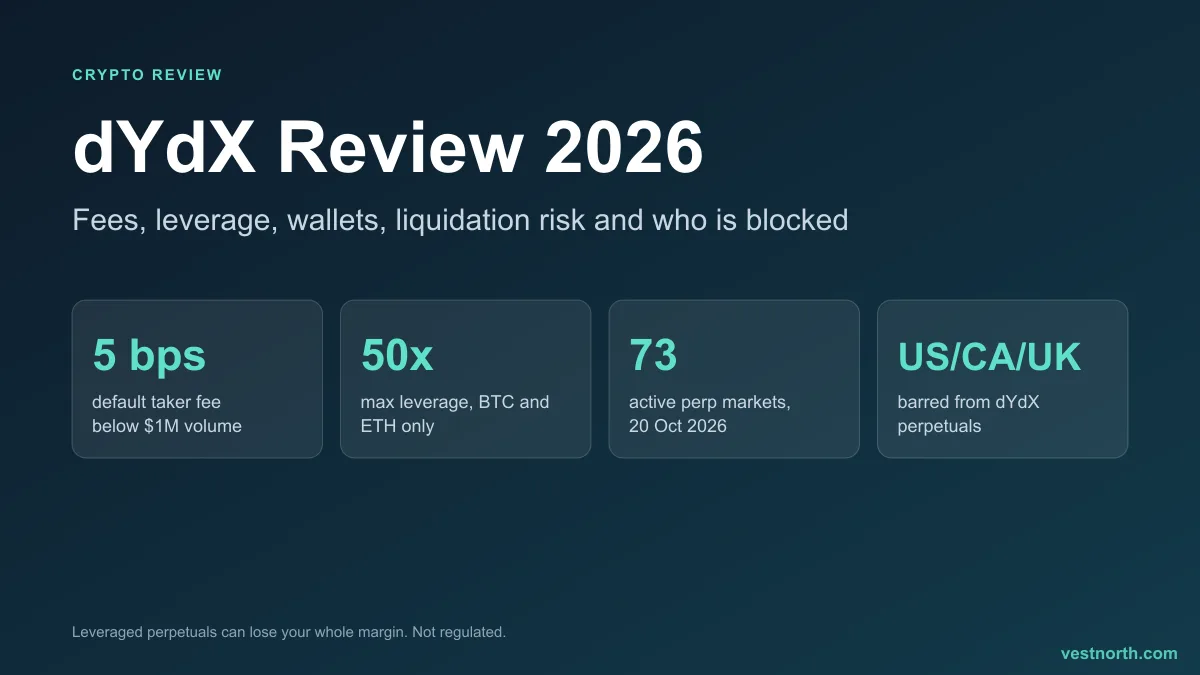 dYdX in four numbers. Sources: dYdX docs, Terms of Use and indexer, October 2026.
dYdX at a glance
| What it is | Decentralised exchange for crypto perpetual futures on dYdX Chain, a standalone blockchain built with Cosmos SDK and CometBFT |
| Custody | Self-custody: you control the secret phrase of your dYdX Chain address |
| Front end | dydx.trade, listed as operated by dYdX Operations Services Ltd. |
| Software developer | dYdX Trading Inc., which says it does not run any public front end or the chain |
| Regulation | We found no statement that the front end or protocol is licensed by a financial regulator |
| Trading fees | Default 5.0 bps taker / 1.0 bps maker below $1M of 30-day volume |
| Gas to trade | None by default; deposits and withdrawals pay network or bridge fees |
| Leverage | Up to 50x on BTC-USD and ETH-USD; 20x on SOL-USD; 10x or 5x on the rest (20 October 2026) |
| Active markets | 73 on the indexer on 20 October 2026; the website shows 99 and also says “200+ markets” |
| Collateral | USDC (Noble USDC on dYdX Chain) |
| Apps | Web, iOS, Android and Telegram, according to dydx.xyz |
| Not available to | US, Canada, UK (perpetuals), plus sanctioned countries and regions |
Pros
- Self-custody: the software developer says it never holds your wallet, keys or recovery phrase
- Default fees of 5.0 bps taker and 1.0 bps maker, with no charge for cancelled orders and no gas fee per trade
- Maker rebates at the two highest volume tiers (-0.7 and -1.1 bps)
- Published liquidation formulas with worked examples, so you can calculate your own liquidation price
- Several ways in: MetaMask, Phantom (Solana), Keplr, WalletConnect, Ledger via MetaMask, or an email/social login
- No minimum withdrawal amount, according to the help centre
Cons
- No regulator and no deposit insurance: losses from bugs, exploits or mistakes are yours
- Closed to the US, Canada and the UK for perpetuals, with wallets moved to close-only mode and then blocked
- Liquidation penalty of up to 1.5% by default, and deleveraging can close profitable positions early
- Fees, leverage and limits are set by governance and can change
- Most markets allow only 5x or 10x, so the 50x headline applies to two markets
- The official pages give three different market counts
How dYdX works and who runs it
dYdX is open-source software. Its developer, dYdX Trading Inc. (“DTI”), describes it as software for “a standalone blockchain built using Cosmos SDK and CometBFT, which can be deployed to power a decentralized exchange offering perpetual contracts trading” (source). The same Terms say DTI “does not deploy dYdX Software for public use or operate any infrastructure or website interface” and that the software is “highly experimental”.
So who runs the website you actually use? dYdX’s front end page lists one provider: dYdX Operations Services Ltd., at dydx.trade, with the status page status.dydx.trade (source). The help centre also names dYdX Operations Services Ltd. as the operator of “the frontends” and says it “does not run dYdX Chain validators nor operate or control the dYdX Chain network” (source).
The dYdX Operations subDAO site explains that the community funds this work through the Digital Operations Foundation (previously the dYdX Operations Trust), whose job includes making sure “one frontend, one indexer and one iOS app are always available to users” (source). The information site dydx.xyz is a third company again: dYdX International Ltd, incorporated in the Cayman Islands (source).
In practice this means there is no single company that holds your money and answers to a regulator. The chain is run by validators, the front end by an operations company, and the code by a developer that disclaims responsibility for both. We could not confirm where dYdX Operations Services Ltd. is incorporated.
Is dYdX safe? Custody, insurance and regulation
Short answer: your funds sit in a blockchain address you control, which removes the risk of an exchange freezing or losing customer deposits. It adds other risks: software failure, wallet mistakes, liquidation and the lack of any regulator or compensation scheme.
Self-custody and your secret phrase
When you connect an Ethereum or Solana wallet, dydx.trade asks you to sign a message that generates a dYdX Chain wallet from it (source). That address is controlled by a 24-word secret phrase that you can export, and the help centre warns that “whoever knows the seed phrase for a wallet address can send, trade, and sell coins or tokens” (source).
DTI’s Terms say it “does not take possession or custody of, manage, store or have access to any Wallets, recovery phrases, private keys” and that losing them “will permanently and irreversibly deny you access” to your assets (source). Nobody can reset a lost phrase for you.
No deposit insurance or regulator protection
We found no statement on dYdX’s official pages that dydx.trade or the protocol is licensed or supervised by a financial regulator. There is no deposit insurance or investor compensation scheme for balances on dYdX Chain. The Terms ask you to accept risks including “software coding errors, software failures, software vulnerabilities or software errors leading to exploits”, blockchain outages and regulatory action that could “impede or limit your ability to access or use dYdX Software” (source).
The protocol does have an insurance fund, but it is a trading mechanism, not protection for your deposit. It receives liquidation penalties and pays to help liquidation orders fill (source). If an account’s value turns negative, deleveraging happens “immediately against randomly chosen offsetting positions” without using the insurance fund, which can cut the profit of a trader on the winning side (source).
Governance can change the rules
Almost every help article on fees, liquidations and margin says the default value “will be subject to adjustments by the applicable Governance Community” (source). Withdrawals can also be paused: transfers and withdrawals are gated for 50 blocks if a negative account cannot be liquidated or the chain has an outage of 5 minutes or more, and Noble USDC withdrawals are rate limited by default to the greater of 1% of total value locked or $1 million per hour (source).
dYdX trading fees
dYdX uses a maker-taker model. A maker order rests on the order book, a taker order fills immediately against it. Your tier depends on 30-day trading volume across all perpetual markets, and the docs say fees are the same in every market (source).
| Tier | 30-day volume | Taker | Maker |
|---|---|---|---|
| 1 | Under $1M | 5.0 bps | 1.0 bps |
| 2 | $1M or more | 4.5 bps | 1.0 bps |
| 3 | $5M or more | 4.0 bps | 0.5 bps |
| 4 | $25M or more | 3.5 bps | 0 |
| 5 | $50M or more | 3.0 bps | 0 |
| 6 | $100M or more | 2.5 bps | -0.7 bps |
| 7 | $200M or more | 2.5 bps | -1.1 bps |
One basis point (bp) is 0.01%. Negative maker fees are rebates paid to you. The docs point to the fees page in the dydx.trade portfolio for the latest schedule, so check it before trading.
Worked example (tier 1): opening a $10,000 position with a taker order costs $5.00 (5 bps). Closing it with another taker order costs another $5.00, so the round trip costs $10.00 before funding. With maker orders on both sides it would cost $2.00. These fees apply to the full position size, not to your margin, so leverage multiplies them too.
Other default rules from the help centre: no fee for cancelled orders, no gas fee to place trades, and fees accrue to validators and stakers (source). Staking DYDX tokens can reduce fees: at tier 1, staking 3,000 DYDX gives a 25% discount and 20,000 DYDX gives 50%, according to the docs. The discounts do not apply to maker rebates.
Promotions: dYdX runs monthly “Surge” campaigns. Past seasons listed on its rewards page included zero fees on BTC and BONK perpetuals and fee rebates; the most recent listed season ended on 31 May 2026 and is shown as inactive (source). We could not confirm any fee promotion active in October 2026.
Referral link: the help centre says users who join through an affiliate link get fee-tier discounts “starting at fee tier 3”, which it says can save up to $550 in fees (source). VestNorth may earn a commission if you use our link; it does not change your fees beyond that discount.
Funding payments
Perpetual contracts have no expiry, so dYdX uses hourly funding payments to keep the contract price close to the oracle price. When the perpetual trades above the oracle price, longs pay shorts; when it trades below, shorts pay longs (source). The default interest rate component is 0%, and the trade page shows the 1-hour, 8-hour and annualised rate for each market. Funding can cost more than trading fees on a position held for weeks.
dYdX leverage and margin by market
Each market has an initial margin fraction (IMF), the collateral needed to open a position, and a maintenance margin fraction (MMF), the collateral needed to keep it open (source). Maximum leverage is 1 divided by the IMF. If you are new to these terms, read what leverage is first.
On 20 October 2026 the dYdX indexer listed 73 active perpetual markets with these margin settings (source):
| Initial margin | Maximum leverage | Active markets | Examples |
|---|---|---|---|
| 2% | 50x | 2 | BTC-USD, ETH-USD (maintenance margin 1.2%) |
| 5% | 20x | 1 | SOL-USD (maintenance margin 3%) |
| 10% | 10x | 27 | Other listed tokens |
| 20% | 5x | 43 | Smaller and newer tokens |
The governance docs list the same liquidity tiers, from Large-Cap (2% initial margin) to Long-Tail (20%), plus a “Safety” tier at 100% that allows no leverage (source). An older table in the help centre’s funding article shows 5% initial margin for large caps, so treat the live market data as the current figure.
Required margin also rises as a market gets crowded. Once open interest passes a market’s lower cap, the IMF increases in a straight line up to 100% at the upper cap, “requiring 1:1 collateral for trading” (source). You can trade in cross margin, where all positions share one balance, or isolated margin, where each position has its own.
Liquidation: how much can you lose?
If your account value falls below the total maintenance margin requirement, the liquidation engine can close your positions in part or in full (source). By default the engine tries to leave money in your account after a maximum liquidation penalty of 1.5%, but the same article says “up to the entire remaining value of the account may be taken as penalty”. The liquidity tiers article describes the fee as “at least 1%” and possibly higher depending on liquidity (source). The two articles word this differently; we show both.
The help centre gives its own example. A trader deposits $1,000 and shorts 3 ETH at $3,000 with a 5% maintenance margin. The liquidation price works out to about $3,174.60, a rise of under 6%. At that point the remaining equity is about $476.20, and liquidation can then take its penalty and close the position. Liquidations use the oracle price, so a fast spike can trigger them even if your own chart looked calm.
Getting started: wallet, deposit and withdrawal
You need a wallet. dydx.trade supports MetaMask, Phantom (Solana), Keplr, WalletConnect and Coinbase Wallet, and Ledger works through MetaMask. Keplr with Ledger is not supported (source). Without a wallet, an email or social login powered by privy.io creates a dYdX Chain wallet with a 24-word phrase and two-factor authentication.
Each wallet creates its own dYdX Chain address. You cannot connect several wallets to one account, and you cannot move open positions between wallets.
Deposits: you deposit USDC from supported chains through a deposit flow powered by Skip, or send USDC on the Noble network directly or from Coinbase (source). The dydx.xyz homepage lists deposits from six chains (Ethereum, Base, Arbitrum, Polygon, Avalanche and Optimism) and says “$100+ Deposits are Free” (source). The help centre says a Noble deposit should appear in about 30 seconds, and to contact support if an instant deposit has not arrived after 5 minutes or a standard one after 30 minutes (source).
Minimum: we could not find a stated minimum deposit. The help centre says 20 USDC of equity allows one open order and 100 USDC allows ten, and isolated positions need at least 20 USDC of margin (source).
Withdrawals: there is no minimum withdrawal amount. You can withdraw USDC to Coinbase, which the help centre says is the only centralised exchange that supports Noble USDC withdrawals from dYdX, or to an address on another supported chain. The withdrawal window deducts the destination network’s fees and shows the amount you will receive before you confirm (source). A MetaMask address can only withdraw to EVM chains, a Keplr address to Cosmos chains, and Phantom to Solana.
Is dYdX available in my country?
The dYdX Software Terms (last updated 12 March 2026) define two groups of “Restricted Persons” (source):
- Perpetuals trading: people or entities who reside in, are located in, are incorporated in, or are operated or controlled from the United States, Canada or the United Kingdom.
- All dYdX software: anyone connected to a “Restricted Territory”, defined as Iran, Cuba, North Korea, the regions of Crimea, Donetsk or Luhansk, or any other country or region under comprehensive US sanctions; plus sanctioned persons and anyone whose use breaks applicable law.
The MegaVault and affiliate sections of the same Terms add Syria and Myanmar (Burma) to the named list. Using a VPN to get around the rules is prohibited, and DTI says it may restrict use further at any time.
The help centre explains what happens in practice. It names the United States, Canada, the United Kingdom and sanctioned countries such as Iran and North Korea, and says your IP address is checked on every page load (source). A wallet that connects from a restricted location goes into close-only mode: you can cancel orders, reduce positions and withdraw, but not deposit or open trades. After 7 consecutive days it becomes blocked, and only the secret phrase can still be exported.
Other features
- MegaVault: you can add USDC that is used to run automated trading strategies across dYdX markets, including “high risk, illiquid and volatile markets”. The help centre says “there is material risk of loss” and that the vault depends on an operator who may have “little or no operating history” (source). The Terms say MegaVault may not be used in the US or other restricted jurisdictions.
- Spot trading and mobile: dydx.xyz links to a spot section at dydx.trade/spot and lists iOS, Android and Telegram access (source). This review covers the perpetuals product only.
dYdX alternatives
| If you want… | Compare |
|---|---|
| A centralised exchange with customer support and fiat deposits | Kraken review |
| A Solana DEX for spot swaps and perps | Jupiter review |
| Leverage with a regulated provider | Brokers or exchanges licensed in your country for retail derivatives |
Bottom line
dYdX gives experienced traders an on-chain order book for crypto perpetuals with low default fees (5.0 bps taker, 1.0 bps maker at tier 1), self-custody of funds, and up to 50x on BTC and ETH. The help centre publishes its liquidation and margin formulas, so you can work out your risk before you trade.
The trade-offs are real. There is no regulator, no deposit insurance, and no company that will make you whole after a bug or a lost phrase, and governance can change fees and margin rules. Perpetuals are barred in the US, Canada and the UK. If you are eligible, start with a small amount, keep leverage well below the maximum, and only deposit money you can afford to lose.
- Self-custody: trade perps from your own wallet
- Default fees 5.0 bps taker / 1.0 bps maker
- Up to 50x on BTC and ETH; 5x–10x on most markets
Regulator warning for your country: dYdX's terms bar residents of Canada from trading perpetuals. A wallet that connects from a restricted country is switched to close-only mode and blocked after 7 days. Check that a broker is authorised where you live before depositing. dYdX geo-restrictions
Regulator warning for your country: dYdX's terms bar UK residents from trading perpetuals. A wallet that connects from a restricted country is switched to close-only mode and blocked after 7 days. Check that a broker is authorised where you live before depositing. dYdX geo-restrictions
dYdX does not accept clients from your country, so we don't link to it here. See other crypto platforms, and always check that a platform is authorised where you live.
Frequently asked questions
Is dYdX safe?
dYdX is non-custodial: you trade from a dYdX Chain address controlled by your own secret phrase, and the software developer says it never holds your funds or keys. It is not a regulated broker, there is no deposit insurance, and the Terms list software bugs, exploits, liquidation and regulatory action as risks you accept.
What are dYdX trading fees?
The default schedule in the dYdX docs starts at 5.0 bps (0.05%) for takers and 1.0 bps (0.01%) for makers below $1M of 30-day volume, falling to 2.5 bps taker and a 1.1 bps maker rebate above $200M. Cancelled orders cost nothing and there is no gas fee to trade. Governance can change the schedule.
What is the maximum leverage on dYdX?
It depends on the market. On 20 October 2026 the dYdX indexer showed an initial margin fraction of 2% for BTC-USD and ETH-USD (50x), 5% for SOL-USD (20x), and 10% or 20% (10x or 5x) for the other active markets.
Can US residents use dYdX?
No. The dYdX Software Terms bar people who live in, are located in or are incorporated in the United States, Canada or the United Kingdom from the perpetuals software, and the dydx.trade help centre says wallets connecting from those countries are put into close-only mode and then blocked.
Who runs dydx.trade?
The dydx.trade front end is listed as operated by dYdX Operations Services Ltd. The open-source software is written by dYdX Trading Inc., which says it does not run any public front end or the dYdX Chain itself.
Is there a minimum deposit on dYdX?
We could not find a stated minimum deposit. The help centre says 20 USDC of equity allows one open order and 100 USDC allows ten, and isolated positions need at least 20 USDC of margin. The dYdX website says deposits of $100 or more are free.
Does dYdX have an insurance fund?
Yes, the protocol has an insurance fund that absorbs liquidation losses and receives liquidation penalties. It is not deposit insurance: it does not protect your balance, and if an account goes negative the protocol can deleverage profitable traders instead.
Sources
- dYdX Software Terms of Use (dYdX Trading Inc., updated 12 March 2026)
- dYdX Help Centre: Geo-restrictions and site access
- dYdX International: Terms of Use for dydx.xyz
- dYdX: dYdX Chain front end options
- dYdX Operations subDAO
- dYdX docs: Rewards, fees and parameters
- dYdX Help Centre: Trading fees
- dYdX docs: Governance and liquidity tiers
- dYdX docs: Margining
- dYdX indexer: perpetual markets (live data)
- dYdX website (dydx.xyz)
- dYdX: Community rewards and campaigns
- dYdX Help Centre: Liquidations
- dYdX Help Centre: Liquidity tiers
- dYdX Help Centre: Contract loss mechanisms
- dYdX Help Centre: Funding rates
- dYdX Help Centre: Connect your wallet and start trading
- dYdX Help Centre: Supported wallets
- dYdX Help Centre: Secret phrase
- dYdX Help Centre: Troubleshooting deposits
- dYdX Help Centre: How to withdraw
- dYdX Help Centre: Equity tiers and rate limits
- dYdX Help Centre: MegaVault FAQ
- dYdX Help Centre: Affiliate program FAQ
Sources checked on October 23, 2026. Broker terms change often: confirm the current conditions on the broker's own site before you open an account.